Lumentum (LITE): The Core Supplier of AI Optical Infrastructure — Worth Playing With Options?
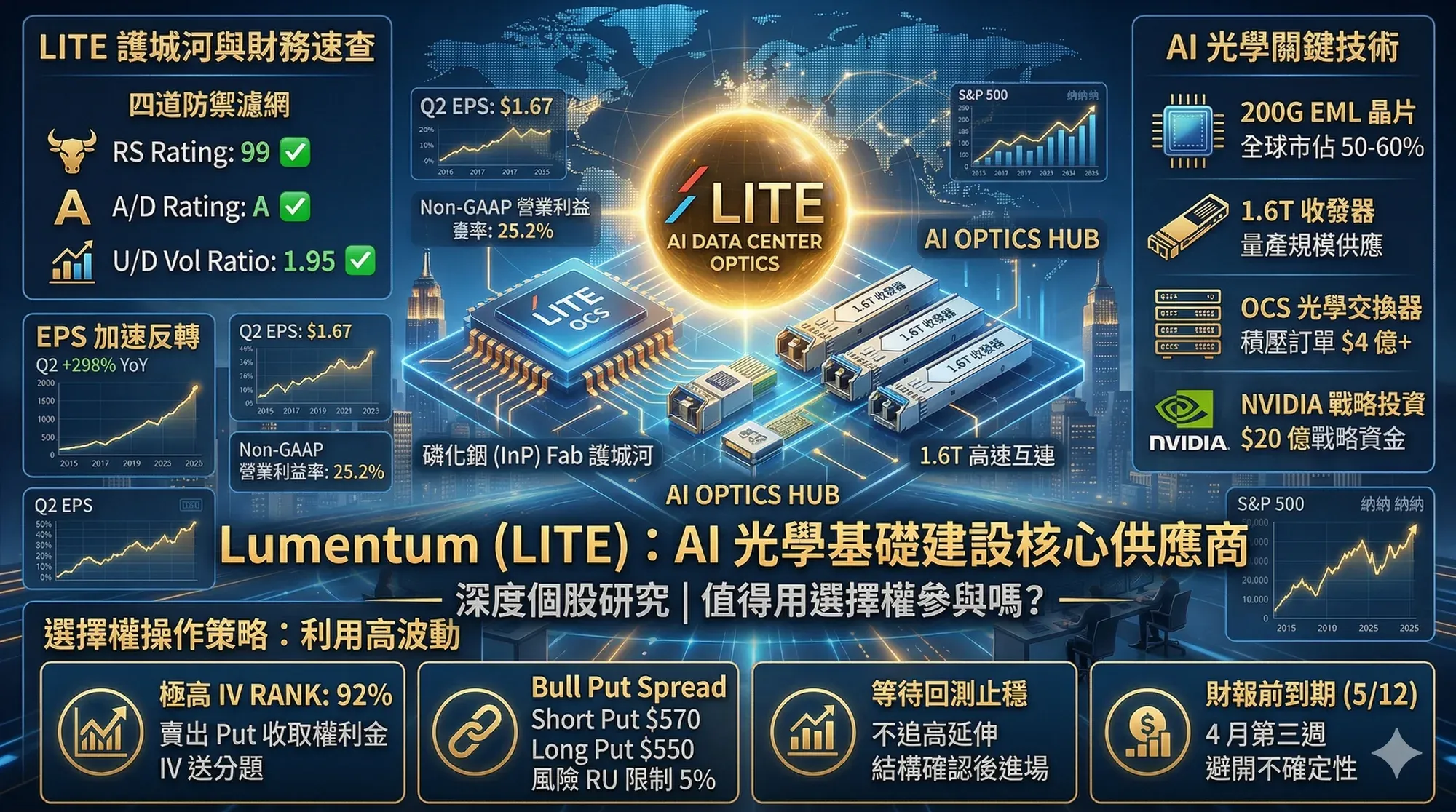
LITE (Lumentum Holdings) holds 50-60% share of the 200G EML market and is a key supplier for 1.6T transceivers. A $2 billion strategic investment from NVIDIA, S&P 500 inclusion, and a 92% IV Rank — a full assessment of the options opportunity.
Stock Research #LITE
Ticker: LITE|Exchange: Nasdaq|Sector: AI Optical Interconnect / Photonics
📅 Published 2026/03/19 · ⏱ 20 min read · 📊 Q2 FY2026 · Includes industry map / earnings-call highlights / bull-bear debate
Lumentum (LITE) holds a structural moat in the AI optical-infrastructure space — an in-house InP fab, a 50–60% share of the global 200G EML market, and it's currently the only vendor able to supply the key components for 1.6T transceivers at production scale. NVIDIA made a $2 billion strategic investment with multi-year purchase commitments attached, and LITE was added to the S&P 500 on March 23. All three of RS 99, A/D A, and IV Rank 92% clear the screen, but the technical picture is stretched, trading +33.6% above the 50MA — best to wait for a pullback and structural confirmation after 3/23 before entering via a Bull Put Spread.
Data as of Q2 FY2026 / IBD MarketSurge
| Filter | Metric | Data | Result |
|---|---|---|---|
| 1: Flow | RS Rating | 99 | ✅ Go |
| A/D Rating | A | ✅ Go | |
| U/D Vol Ratio | 1.95 | ✅ Buying nearly double selling | |
| 2: Moat | ROE | 29.27% | ✅ Go |
| SMR Rating | A | ✅ Go | |
| EPS Acceleration Trend | V-shaped recovery underway | ✅ Conditional go | |
| 3: Volatility | IV Rank | 92% | ✅ Extremely rich |
| Next earnings | 2026-05-12 | ⚠️ DTE must be controlled | |
| 4: Technicals | Price vs. 50MA | +33.6% extended | ⚠️ Wait and watch |
| 50MA | $524.6 | Support reference |
INTRODUCTIONIntroduction: Plumbing and Wiring, Not a Star Stock
In the investment narrative around AI infrastructure, most investors' eyes are fixed on the flashy names — NVIDIA, Meta, Google. But deep inside the data center, a critical component is quietly becoming the bottleneck — optical interconnect.
As GPU clusters scale up, the bandwidth and power limits of traditional copper cabling are starting to show. The speed at which data moves between GPUs and servers is becoming the ceiling on the efficiency of the entire AI training process. Lumentum (LITE) is one of the core suppliers solving this bottleneck.
LITE is the "plumbing and wiring" manufacturer of AI infrastructure. The GPU is AI's brain; the optical module is AI's nervous system.— ProfitVision LAB, 2026/03/19
CHAPTER 01Industry Map: Why Must AI Use Fiber Optics?
1.1 The Physical Limit: the 2-Meter Copper Problem
This is a physics problem, not a business choice. The industry calls it the "2-Meter Limit" — at 1.6T speeds, copper cabling suffers severe signal degradation past 2 meters, and the heat it generates can't be absorbed by the data center. The 800G generation was already near this ceiling; 1.6T is the forced tipping point for conversion.
1.2 The Three Architectural Layers of Optical Interconnect
| Architecture Layer | Technical Term | Distance | LITE's Role |
|---|---|---|---|
| Scale-Out (between racks) | Pluggable Transceiver | 1–100m | Current core business |
| Scale-Across (between data centers) | Optical Circuit Switch (OCS) | 100m–10km | Emerging high-growth engine |
| Scale-Up (within a node) | Co-Packaged Optics (CPO) | <1m | Entering by end of 2027 |
LITE's strategy is to penetrate layer by layer along these three tiers, extending from its established Scale-Out position toward the higher-value OCS and CPO markets.
CHAPTER 02Anatomy of the Business Model: A Vertically Integrated Moat
2.1 The Vertically Integrated InP Fab — the Real Moat
Most optical-component companies use an "asset-light (fab-lite)" model, designing chips in-house but outsourcing manufacturing. LITE is completely different — it runs end-to-end vertical integration:
2.2 Core Product Portfolio
| Product | Market Position | Growth Driver |
|---|---|---|
| 200G EML laser chip | 50–60% global market share, the only vendor shipping at production scale | Mandatory adoption for the 1.6T generation |
| Pluggable transceiver | Scaling rapidly through the Cloud Light acquisition | Q2 systems revenue up 60% YoY |
| Optical Circuit Switch (OCS) | Saves 40% of data-center power | $400M backlog, customer count up from 1 to 3 |
| Co-Packaged Optics (CPO) | Already won hundreds of millions of dollars in orders | Delivery in 2027H1, a long-term opportunity |
2.3 The Two-Segment Structure
| Segment | Share | Growth Profile |
|---|---|---|
| Cloud & Networking | 88% | The core breakout engine, up 65%+ YoY in Q2 |
| Industrial Tech | 12% | Cyclically weak, currently flat sequentially |
CHAPTER 03Competitive Landscape: Who Are the Rivals, and Who Are the Allies?
3.1 Comparison of Major Competitors
| Company | Ticker | Position | vs. LITE |
|---|---|---|---|
| Coherent Corp | COHR | The leader in optical transceiver production volume, FY25 revenue of $5.8B | Larger scale, but weaker in-house EML capability |
| Fabrinet | FN | Precision optics contract manufacturer (including for LITE) | A manufacturing partner, not a direct competitor |
| Applied Optoelectronics | AAOI | Low-to-mid-tier transceivers, expanding capacity aggressively | A large gap in technology tier |
| Mitsubishi / Sumitomo | Japanese manufacturers | EML competitors | More than 2 years behind on 200G production capability |
3.2 The Biggest Technology-Path Competition: InP EML vs. Silicon Photonics
The InP path (where LITE sits): superior thermal stability and better signal integrity, making it the best technology for 1.6T. High manufacturing difficulty and a high barrier to entry give LITE an overwhelming advantage.
The silicon photonics path (pushed by Coherent / Broadcom): lower manufacturing cost, able to leverage existing semiconductor fabs. Production yields still lag InP today, but are expected to gradually mature after 2028–2029, at which point it will exert substitution pressure on InP.
LITE's countermeasure: it unveiled a 1060nm VCSEL solution at OFC 2026, offering a third technology path to attract customers looking to diversify risk.
3.3 The Dual Nature of the NVIDIA Relationship
NVIDIA is both LITE's most important strategic partner and a potential threat: it has also invested in Coherent, and at OFC 2026 reaffirmed that it will "keep using copper cabling." This is NVIDIA's usual multi-bet strategy — ensuring it's never locked into a single supplier. But the $2 billion NVIDIA investment comes attached with a multi-year purchase commitment and priority capacity-allocation agreement — this isn't a financial investment that can simply be dropped.
CHAPTER 04Financial Analysis: An Accelerating Recovery Off the Bottom
4.1 Quarterly EPS Acceleration Trend
| Quarter | EPS ($) | EPS YoY | Revenue (M) | Revenue YoY |
|---|---|---|---|---|
| Jun-24 | $0.06 | -90% (the bottom) | $308.3 | -17% |
| Sep-24 | $0.18 | -49% | $336.9 | +6% |
| Dec-24 | $0.42 | +31% | $402.2 | +10% |
| Mar-25 | $0.57 | +97% | $425.2 | +16% |
| Jun-25 | $0.88 | +1,367% | $480.7 | +56% |
| Sep-25 | $1.10 | +511% | $533.8 | +58% |
| Dec-25 | $1.67 | +298% | $665.5 | +65.5% |
Jun-24 marked the bottom, and every quarter since has been an accelerating rebound. This kind of V-shaped recovery combined with continued acceleration is exactly the most explosive fundamental structure in the Minervini SEPA methodology.
4.2 Core Q2 FY26 Financial Data
| Metric | Q2 FY26 | Q1 FY26 | Q2 FY25 | YoY |
|---|---|---|---|---|
| Revenue | $665.5M | $533.8M | $402.2M | +65.5% |
| Gross margin | 42.5% | 39.4% | 32.3% | +10.2pp |
| Operating margin | 25.2% | 18.7% | 7.9% | +17.3pp |
| Non-GAAP EPS | $1.67 | $1.10 | $0.42 | +298% |
| OCS backlog | Surpassed $400M, customer count up from 1 to 3 | Beat expectations | ||
4.3 Forward Estimates
| Fiscal Year | EPS Estimate | YoY | Revenue Estimate | YoY |
|---|---|---|---|---|
| FY2026e | $7.61 | +269% | $2,894.5M | +76% |
| FY2027e | $14.52 | +91% | $4,745.9M | +64% |
CHAPTER 05Highlights From the Last Three Earnings Calls
Q1 FY26 (Nov 2025, Sep-25 quarter)
Revenue of $533.8M (up 58% YoY), EPS of $1.10 beat by $0.07. The Thailand plant's manufacturing upgrade was completed, and management declared "the era of production volatility is over," entering a four-to-five-quarter sustained growth trajectory. Q2 guidance came in at a midpoint of $650M — two quarters ahead of the original target.
"Demand is stronger than we originally estimated."— COO Wupen Yuen, Q1 FY26 earnings call
Q2 FY26 (Feb 2026, Dec-25 quarter) — Latest Results
Revenue of $665.5M (up 65.5% YoY), EPS of $1.67 beat by $0.26. OCS backlog surpassed $400M, hitting the $10M quarterly-revenue milestone a quarter early. Won a "several-hundred-million-dollar" CPO order for delivery in 2027H1. Q3 guidance came in at a midpoint of $805M, up 85%+ YoY.
"Virtually every AI network is powered by Lumentum technology, whether through a direct hyperscaler partnership or as a critical component supplier. The vast majority of the growth is still ahead of us."— CEO Michael Hurlston, Q2 FY26 earnings call
Progress on the Three Growth Catalysts
| Catalyst | Current Status | Notes |
|---|---|---|
| Cloud transceivers | 🟢 Executing | Q2 transceiver systems revenue up $50M sequentially, continuing to accelerate into Q3 |
| OCS | 🟢 Beating expectations | Backlog above $400M+, customer count expanded from 1 to 3, hit its target ahead of schedule |
| CPO | 🟡 Just getting started | Several hundred million dollars in orders already secured; the bulk of revenue arrives 2027H1 |
Q3 FY26 Outlook (to be reported 2026/05/12)
| Item | Guidance | Notes |
|---|---|---|
| Revenue | $780–$830M | Midpoint of $805M, up 89%+ YoY |
| Non-GAAP EPS | $2.15–$2.35 | +29–41% sequentially |
| Non-GAAP operating margin | 30.0%–31.0% | Another substantial improvement |
CHAPTER 06The Full Bull and Bear Case
The Bull Case
The Bear Case
CHAPTER 07Five Tough Questions: A Stress Test
CHAPTER 08Options Strategy Design
Recommended Strategy: Bull Put Spread
Sell a put below a technical support level to collect premium, while buying a lower-strike put as protection. An IV Rank of 92% is a gift — the premium collected from selling options here is far richer than in normal conditions.
Entry conditions (all required):
| Item | Setting | Notes |
|---|---|---|
| Strategy | Bull Put Spread | — |
| Short put | $570 | Below strong support, roughly 50MA + 9% |
| Long put | $550 | Protective leg, $20 wide |
| Expiration | Third week of April | Ensures expiry before earnings (5/12) |
| Target premium | $0.80–$1.20 | Achievable in a 92% IV environment |
| Max loss | $20 - net premium | ⚠️ Must be sized down to fit within the 5% Risk Unit limit |
CHAPTER 09Action Framework: Watchlist
| Timing | Action |
|---|---|
| Now (3/19) | Add to watchlist, take no action |
| 3/23 (inclusion day) | Watch price/volume reaction closely. Light-volume green close → uptrend continues; heavy-volume red close → wait for a pullback |
| 3/24–3/28 | Watch for whether a pullback appears and confirm a stabilization signal |
| First week of April | If the structure confirms, check the IBKR options chain and design the Bull Put Spread |
| By end of April | The position must expire before earnings (5/12) |
📋 Final Verdict: ⏳ Waiting for pullback confirmation
LITE is a rare, strong combination this year — top-tier RS, aggressive institutional accumulation, an accelerating EPS recovery, a strategic NVIDIA endorsement, and a 92% IV Rank. Within the long-term AI infrastructure narrative, optical interconnect is a genuinely existing structural need, not a speculative concept play.
Short term: after the 3/23 inclusion day, wait for pullback confirmation — don't chase the price.
Once confirmed: Bull Put Spread, short put at $570, expiring the third week of April.
Long term: the OCS + CPO growth wave doesn't fully unfold until 2027–2028.
"Wait for the structure, wait with discipline, wait for the right moment."
A true edge never comes from jumping in first.
| Date | Event | Verdict | Follow-Up Result |
|---|---|---|---|
| 2026/03/19 | Initial publication, Q2 FY2026 + IBD data | ⏳ Waiting | — |
▸ Next update: after observing price/volume on the 3/23 S&P 500 inclusion day
▸ Conditions for an earlier update:
① The stock meaningfully retests the 50MA and stabilizes ② A significant change in IV Rank ③ A new NVIDIA statement related to optics ④ The Q3 FY26 earnings report (5/12)