A Question No One Dares Say Out Loud in an Election Year
At its closest point, Kinmen is only 1,800 meters from Xiamen. That's not a 180-kilometer strait wide enough to fight for air superiority — it's 1,800 meters, close enough that on a clear day you can make out the outlines of Xiamen's buildings, and at night you can see the streetlights on the other shore.
At this distance, Taiwan currently stations a nominal 6,000 troops on Kinmen, of whom 3,000 are actually registered, and once you account for two-day weekends, roughly 2,000 are actually on duty at any given time.
Let's ask an honest question: if the PLA were serious about taking Kinmen, how many days could these 2,000 troops hold out?
No publicly available Taiwanese military analysis offers a comforting answer. Across the strait, Quanzhou and Xiamen have artillery and armored units, Xiamen has an air-defense brigade, the Fujian coast has infantry, armor, and special-operations forces, and the Eastern Theater Command can mobilize 280,000 troops. In the 1949 Battle of Guningtou, the CCP assessed that a minimum of "40,000 to 50,000 troops transported in a single wave" was needed to take on Kinmen's then 30,000 defenders — today, Kinmen has only 3,000.
These 2,000 troops are not an effective defensive force — they are a moral liability. But that does not mean Kinmen and Matsu should be evacuated.
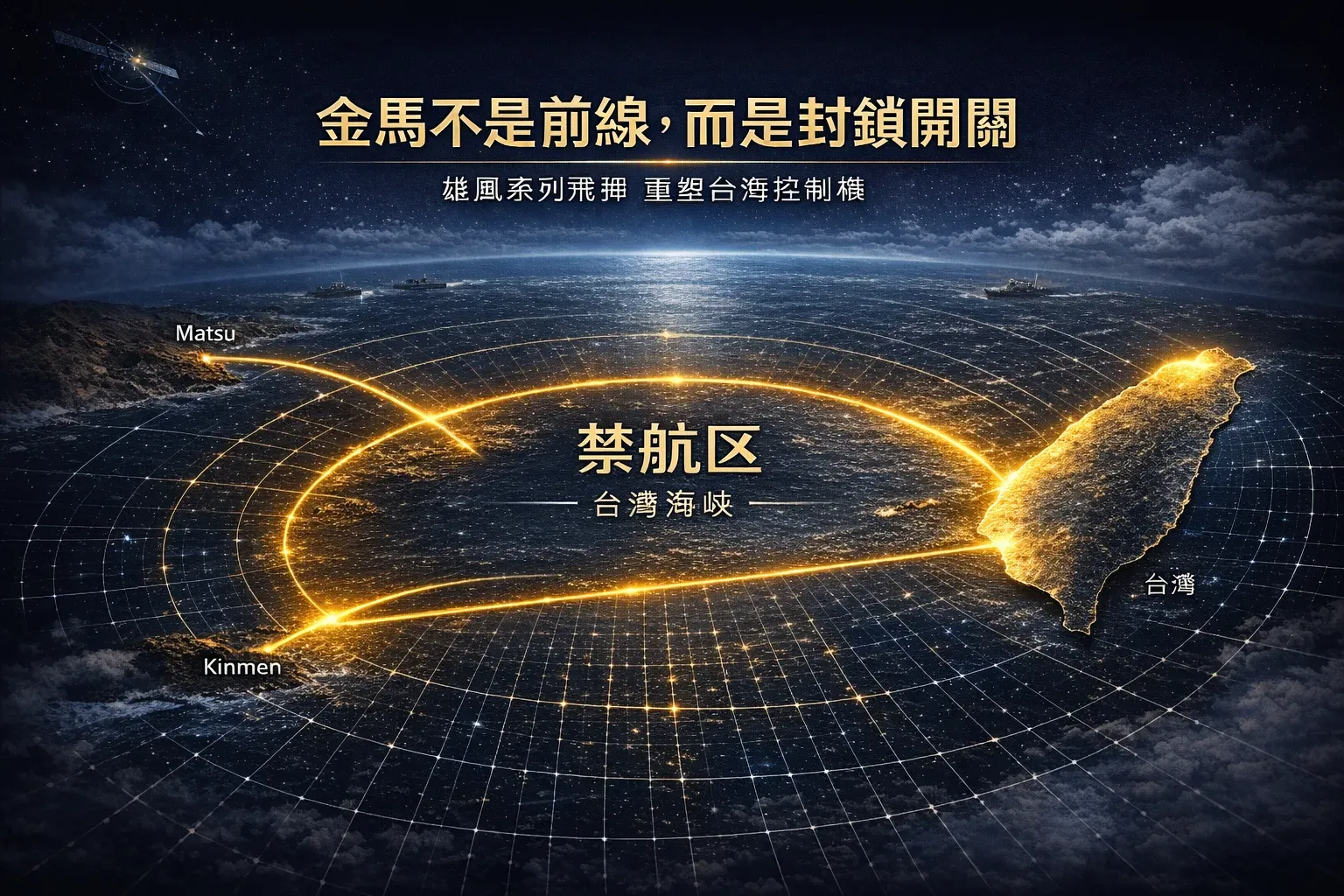
Transform Kinmen and Matsu from "a garrison brigade's burden" into "a forward strike base that blockades the PLA Eastern Theater Command Navy." With 500 elite troops plus the Hsiung Feng II and the extended-range Hsiung Feng III, cover every port from Xiamen to Zhoushan — forcing China's East Sea Fleet into a brutal choice: eliminate Kinmen and Matsu first, take the long way around, or hand the invasion off to the North Sea/South Sea Fleet? Every option drives up the cost of the invasion plan.
The Historical Position and Present-Day Dilemma of Kinmen and Matsu
The offshore islands once had a glorious era of troop strength — to prepare for the plan to retake the mainland, the ROC military stationed 120,000 and 50,000 troops respectively on Kinmen and Matsu. As the political situation changed, Kinmen's garrison was cut down from its peak of 120,000: 55,000 in the early Lee Teng-hui years → 25,000 during the 1996 Taiwan Strait Crisis → reduced to a mere 10,000 in 2007 when brigade-level units were eliminated → down to just 3,000 today.
The logic behind the cuts was correct: modern precision missiles have sharply diminished the strategic value of holding ground with massed traditional forces. But the endpoint of the cuts was wrong: going from 100,000 troops down to 3,000 did reduce the numbers, but it never changed the strategic posture — it's still a "garrison" mindset, just with a severely undermanned garrison.
The way out of this dilemma is to recognize that "how many troops garrison the islands" is not the real policy variable — "the type of deployment" is the real policy variable.
The Hsiung Feng Family's Blockade Ring — The Most Underrated Forward Firepower
1. The Extended-Range Hsiung Feng III Anti-Ship Missile (400 km range)
The extended-range version of the supersonic Hsiung Feng III anti-ship missile, officially named the "Pan Long Program," was funded with NT$44.1 billion under the special budget for the "Sea and Air Combat Power Enhancement Plan." It was publicly deployed for the first time during the Han Kuang No. 41 exercise on July 15, 2025.
(standard Hsiung Feng III is 150km, a 2.7x extension)
less than 60 seconds of radar reaction time for the target ship
full production complete in 2026, deployed to eastern Taiwan
2. The Hsiung Sheng Missile (Hsiung Feng IIE extended-range variant, 1,000–1,200 km range)
The further-extended-range version of the Hsiung Feng IIE cruise missile, internally referred to by the military as the "Hsiung Sheng missile," comes in two variants:
- Variant A (Chi Sun): 500 km range, turbojet engine, land-attack, test flights completed in 2004
- Variant B (Hsiung Sheng): 1,000–1,200 km range, turbofan engine (fuel-efficient, long range), land-attack, test flights completed in 2007
According to a written report the Ministry of National Defense submitted to the Legislative Yuan, the "Hsiung Sheng missile" is equipped with both high-explosive and submunition-dispersal warheads, designed to counter hardened enemy command posts and bunkers, and airfield runways, respectively. Production has been for at least a hundred-plus units, with a production budget of NT$16.1 billion, and production began in 2022.
3. The High-Low, Fast-Slow Pairing — A Double Tear That Gives Defenders a Headache
The most underrated operational advantage of the Hsiung Feng family isn't any single missile's individual performance — it's that when both missile types strike at once, the defender must simultaneously counter two completely different threat physics profiles, and that is the real reason a fleet's air-defense system gets overwhelmed.
- Speed: Mach 2.0+ (supersonic)
- Terminal flight altitude: skimming the sea under 10 meters
- Time from beyond radar horizon to impact: about 30–40 seconds
- Air-defense ship's effective reaction window: essentially zero
it's already within range the instant it appears on radar
- Speed: Mach 0.85 (subsonic)
- Flight altitude: low-altitude sea-skimming throughout
- Range: 500–1,200 km
- Can strike from different bearings and different times
unclear direction of approach, staggered-time attacks, an ammunition war of attrition
For a fleet's air-defense system, this combination creates an unsolvable allocation dilemma:
The extended-range Hsiung Feng III's terminal sea-skimming altitude of under 10 meters makes it nearly impossible for a modern warship's radar to detect it at long range through sea-clutter interference. By the time the target appears on the radar screen, the missile may be only 20 to 30 km from the target ship — at Mach 2.0+, that leaves the close-in weapon system (CIWS) less than 30 seconds to react. This is a hard physical limit, not a training problem.
The Hsiung Sheng applies pressure from a different direction: its 1,200 km range means it can be launched from different angles across Taiwan's main island, leaving the defender uncertain of the direction of attack; its long subsonic flight time means the defender's ammunition-consumption window is stretched out, and a fleet's air-defense missile stockpile is finite.
When both missile types strike within the same time window, the fleet's air-defense commander faces this choice:
- Engage the faster one first (Hsiung Feng III), but the window to identify and intercept the Hsiung Sheng's direction of approach is also running out
- Engage the more numerous one first (Hsiung Sheng), but the sea-skimming, supersonic Hsiung Feng III waits for no one
- Engage both, and the rate of ammunition consumption runs several times faster than the attacker's, because the cost of an interceptor missile is far higher than the cost of an attack missile
This is why the combined deployment of the Hsiung Feng family produces a deterrent effect far greater than the sum of the two missile types' individual numbers — the high-low pairing makes radar detection difficult, the fast-slow pairing pulls the commander in two directions at once, and combined, the design logic is to saturate a fleet's air-defense capacity entirely.
The Shock of the Geographic Math — The Precise Numbers of the Blockade Ring
The following are the precise straight-line distances, calculated using the Haversine formula, from Kinmen (N24.45°, E118.37°) and Dongyin (N26.37°, E120.48°, the northernmost point of Matsu) to the PLA's major ports:
From Kinmen
| Target Port | Distance from Kinmen | Extended-Range HF-III 400km | Hsiung Sheng 1,000km |
|---|---|---|---|
| Xiamen Naval Base | 31 km | ✅ Covered | ✅ Covered |
| Quanzhou Port | 70 km | ✅ Covered | ✅ Covered |
| Fuzhou Mawei Port | 211 km | ✅ Covered | ✅ Covered |
| Ningde Sandu'ao | 317 km | ✅ Covered | ✅ Covered |
| Wenzhou Port | 455 km | ❌ Out of range | ✅ Covered |
| Ningbo Naval Base | ~650 km | ❌ Out of range | ✅ Covered |
| Zhoushan Dinghai (main base) | 719 km | ❌ Out of range | ✅ Covered |
| Shanghai Wusongkou | 830 km | ❌ Out of range | ✅ Covered |
From Dongyin (northernmost point of Matsu, the key node of the blockade ring)
| Target Port | Distance from Dongyin | Extended-Range HF-III 400km | Hsiung Sheng 1,000km |
|---|---|---|---|
| Ningde Sandu'ao | 75 km | ✅ Covered | ✅ Covered |
| Fuzhou Mawei Port | 102 km | ✅ Covered | ✅ Covered |
| Wenzhou Port | 180 km | ✅ Covered | ✅ Covered |
| Xiamen Port | 321 km | ✅ Covered | ✅ Covered |
| Ningbo Naval Base | 403 km | ⚠️ Borderline | ✅ Covered |
| Zhoushan Dinghai (main destroyer force) | 434 km | ⚠️ Near the edge | ✅ Blockaded by Hsiung Sheng! |
| Shanghai Wusongkou | 567 km | ❌ Out of range | ✅ Covered |
Blockade-ring conclusion: if Taiwan deploys the extended-range Hsiung Feng III and the Hsiung Sheng simultaneously on Kinmen and Dongyin, the entire belt of PLA Eastern Theater Command Navy ports from Xiamen to Shanghai falls within the strike range of Taiwan's anti-ship/land-attack missiles. The main base of Destroyer Flotillas 3 and 6 — Zhoushan Dinghai (434 km from Dongyin) — is directly targeted by the Hsiung Sheng missile fired from Dongyin.
The False Problem of Target Identification: China Solved This Problem for Taiwan
Once the coverage of the blockade ring is confirmed, the question most often raised is: how does a missile know which ship to hit? The Taiwan Strait isn't a desert — in peacetime there is heavy civilian shipping traffic. Can the Hsiung Feng III's active radar homing (ARH) seeker correctly identify its target?
The 2016 Jinjiang incident is the example most often cited for this concern — a Hsiung Feng III accidentally struck the 50-ton fishing boat Hsiang Li Sheng, killing the captain. Critics use this case to argue that the Hsiung Feng III's real-world target identification is unreliable.
This critique diagnoses the problem incorrectly.
The Truth Behind the Jinjiang Incident: The ARH Wasn't at Fault — the Operating Environment Was
The design logic of the Hsiung Feng III's ARH seeker is "lock onto the target with the largest radar cross-section." This design is exactly right when engaging a fleet — a frigate has one to two orders of magnitude greater radar cross-section than a merchant ship, so the seeker naturally locks onto the warship.
But on the day of the Jinjiang incident, there was no warship in the firing box — only a 50-ton fishing boat. The ARH found the target with the largest radar cross-section within the box and faithfully executed its design — the problem was that the target was a fishing boat.
Let's spell out this gap with numbers:
| Target | Displacement | Estimated Radar Cross-Section | Compared to the Fishing Boat |
|---|---|---|---|
| Hsiang Li Sheng fishing boat (Jinjiang incident) | 50 tons | ~10–50 m² | Baseline |
| PLA Type 054A frigate | 4,000 tons | ~500–3,000 m² | 60–100x |
| PLA Type 052D destroyer | 7,500 tons | ~1,000–5,000 m² | 100–500x |
| PLA Type 071 amphibious transport dock | 20,000 tons | 10,000+ m² | Several hundred times |
| PLA Type 075 amphibious assault ship | 40,000 tons | Enormous | Beyond comparison |
If a 7,500-ton Type 052D destroyer had been in the firing box that day, the ARH wouldn't have even bothered looking at the fishing boat's radar return — the radar cross-section differs by at least two orders of magnitude. The Jinjiang incident was an environmental problem, not a technical one. The operating environment in wartime is completely different from peacetime.
The Three-Layer Mechanism for Wartime Target Acquisition
Once a conflict in the Taiwan Strait breaks out, target acquisition doesn't rely on a single method — three layers of mechanisms activate in sequence:
Layer One — Taiwan-US-Japan intelligence sharing + the TTN tactical network (pre-crisis / early stage of hostilities): the $11.1 billion arms sale in December 2025 explicitly includes the "Taiwan Tactical Network (TTN) and Tactical Assault Kit (TAK)," designed specifically to let Taiwan receive real-time target coordinates from the US. In the early stage of a conflict, while communication channels are still intact, US satellites and RC-135 reconnaissance aircraft can provide real-time positions of vessels at ports on the other side of the strait, pre-assigning grid coordinates to each missile battery.
Layer Two — MQ-9B-class reconnaissance drones (gray-zone / crisis-escalation stage): the MQ-9B Sea Guardian, equipped with the SeaVue AESA maritime surveillance radar, can continuously monitor a target sea area for over 40 hours from an altitude of 40,000 feet, with virtually no ambiguity in distinguishing a large warship (a radar cross-section of thousands of square meters) from a fishing boat (tens of square meters). In the gray-zone stage before a high-intensity conflict, this is the most reliable real-time target-confirmation platform.
Layer Three — exclusion zones + kill boxes + ARH active homing (the formal engagement stage): this is the most critical, and most underrated, mechanism in wartime.
The Legal Precedent for Exclusion Zones: the Falklands TEZ Model
During the 1982 Falklands War, the UK declared a "Total Exclusion Zone" (TEZ) around the Falkland Islands, treating any ship or aircraft within a 200-nautical-mile radius as a legitimate target for attack without requiring individual identification. This framework won broad recognition under international law and became the standard precedent for wartime maritime control.
Taiwan's version: immediately upon the outbreak of conflict, declare a "Taiwan Strait Combat Exclusion Zone," giving civilian vessels a 24-to-48-hour evacuation notice. After that, operate using "kill boxes" — dividing the strait into a fixed grid, with each cell having a pre-set center coordinate. Missiles fly to the grid center and then activate ARH, searching for and locking onto the largest radar return.
Once the exclusion zone has been cleared of civilian vessels, any large radar return that appears within a cell can be reasonably assumed to be a PLA vessel, or a civilian roll-on/roll-off ferry requisitioned by the PLA (under international law, a civilian vessel performing a military mission is a legitimate military target). The ARH's "blindness" — looking only at radar cross-section, not friend or foe — actually becomes an advantage within this framework: no identification error, no room for electronic deception, just strike the largest target.
The lesson of the Jinjiang incident is not "the ARH is unreliable" — it's "an operating procedure designed for the wrong environment was executed in the wrong environment." Once an exclusion zone is declared in wartime and civilian vessels are cleared, the Jinjiang tragedy becomes, technically, a proof of concept: the ARH worked exactly as designed — there simply wasn't a warship in the box that day. Next time there's a Type 075 amphibious assault ship in the box, the seeker will give you a perfect answer.
China's Claim That the Taiwan Strait Is "Internal Waters" — This Legal Claim Solves the Problem for Taiwan in Wartime
Now we arrive at the most elegant closed loop in this entire argument.
China has long claimed that the Taiwan Strait is its "internal waters" — or at minimum, "waters under Chinese jurisdiction" — refusing to recognize the Strait as international waters open to free navigation. This claim has consistently been rejected diplomatically by the US, Japan, the EU, and other democracies, but China has never abandoned it.
This legal claim produces a consequence in wartime that China may not have anticipated:
First, if the Taiwan Strait is China's "internal waters," then China bears the responsibility to clear its own Chinese civilian vessels from those "internal waters" before the outbreak of hostilities. One of the basic principles of the law of armed conflict is that a belligerent has an obligation to keep civilians (including civilian vessels) away from an expected battlefield. A state that claims sovereignty over a body of water bears the highest responsibility for the safety of its own civilians within it.
Second, if China fails to clear the zone, then any casualties among Chinese vessels remaining in "China's own internal waters" reflect a failure of the Chinese government's own administration — not a Taiwanese target-identification problem. Taiwan will have already declared an exclusion zone and given evacuation notice. Legal responsibility for any large Chinese vessel that remains within the exclusion zone lies with China.
Third, what about third-country merchant ships? Since China itself claims the Strait as its own "internal waters," third-country vessels shouldn't be there in the first place — this is a legal consequence of China's own claim. If a third-country ship really is still within the exclusion zone, that is a diplomatic liability caused by China's failure to clear "its own claimed waters" — it cannot be attributed to Taiwan.
The legal closed loop: China says the Taiwan Strait is its own sea — fine, in wartime we follow that logic. Ships in your sea are your problem. Taiwan declares an exclusion zone and strikes every large radar return. Legal responsibility lies with China, because China failed to clear the vessels out of "the waters it itself claims to own." Every ARH lock-on is backed by China's own legal claim.
The Dilemma of the Eastern Theater Command Navy — the Strategic Coercion Effect of the Blockade Ring
The Real Scale of the PLA Eastern Theater Command Navy
| Ship Class | Estimated Number | Main Home Port |
|---|---|---|
| Type 052D destroyer | 11+ | Zhoushan Dinghai |
| Type 052C destroyer | 4 | Zhoushan Dinghai |
| Type 956/956EM destroyer | 4 | Zhoushan, Ningbo |
| Type 054A frigate | 11+ | Zhoushan Dinghai |
| Type 056A corvette | 11+ | Various bases |
| Type 071 amphibious transport dock | 3 | Zhoushan |
| Type 072 series landing ship | 12+ | Zhoushan, Shanghai |
| Type 075 amphibious assault ship | Deployed | Eastern coast |
This fleet's core Destroyer Flotillas 3 and 6 are based at Zhoushan Dinghai, 434 km from Dongyin — directly covered by Taiwan's Hsiung Sheng missile.
Three Unsolvable Dilemmas
The Strategic Significance of Forced Substitution — the Cost of Handing the Invasion to the North Sea/South Sea Fleet
The Difference in Logistical Distance: A Cost You Can See at a Glance
| Fleet | Main Base | Distance to Taiwan's West Coast | Relative to the Eastern Theater Command |
|---|---|---|---|
| Eastern Theater Command (East Sea Fleet) | Zhoushan Dinghai | ~930 km | Baseline |
| Northern Theater Command (North Sea Fleet) | Qingdao | ~1,850 km | ~2x |
| Southern Theater Command (South Sea Fleet) | Zhanjiang / Sanya | ~1,200–1,500 km | ~1.5x |
A doubled logistical distance means: higher fuel consumption (a greater need for supply ships); longer transit time (more time for Taiwan to prepare and mobilize); and a fleet exposed at sea for longer (higher risk of being struck by submarines and land-based missiles).
The Concentration Problem With Amphibious Vessels
The PLA's most important amphibious warfare vessels (the Type 075 amphibious assault ship, the Type 071 amphibious transport dock) are currently concentrated mostly at ports under the Eastern Theater Command Navy's jurisdiction. If the Eastern Theater Command Navy is blockaded, transferring these core amphibious vessels to the Northern or Southern Theater Command would itself be a large-scale military operation taking weeks — and that transfer process itself would be the clearest possible signal of intent to invade, giving Taiwan and the international community ample warning time.
The essence of deterrence: it isn't about matching force with equal force — it's about using a limited forward deployment to make every viable option available to the other side more expensive. Kinmen and Matsu's Hsiung Feng blockade ring makes the PLA's invasion plan costly from the "preparation stage" onward.
Designing the Transformation — A Complete Firepower Configuration
Kinmen: A 1,500-Troop Forward Strike Base
| Unit | Headcount | Primary Mission |
|---|---|---|
| HIMARS batteries ×6 | 150 | ATACMS strikes on ports/airfields (300km), GMLRS suppression around Xiamen |
| Extended-range Hsiung Feng III launchers ×4 | 60 | Supersonic anti-ship strikes against landing-ship mustering from Xiamen to Ningde ports (supersonic penetration) |
| Hsiung Sheng missile launchers ×4 | 60 | 1,000km land-attack, covering command/logistics nodes from Zhejiang to Shanghai |
| Sea Dragon frogman special-operations squadron | 200 | Underwater reconnaissance, target designation behind enemy lines |
| Kamikaze attack drone battalion | 150 | 400 units: beach anti-armor, target designation |
| Field air-defense company | 200 | Tien Chien air defense, shoulder-fired missiles |
| Ground reconnaissance platoon | 100 | Target acquisition, intelligence relay |
| Logistics support | 280 | Ammunition resupply (underground tunnel storage), equipment maintenance |
| Coast guard/medical/comms | 300 | Satellite communications, emergency evacuation, coast guard coordination |
| Total | 1,500 |
Dongyin (Matsu's Northernmost Point): The Key Node Covering the East Sea Fleet's Main Force at Zhoushan
| Unit | Headcount | Coverage Targets |
|---|---|---|
| Extended-range Hsiung Feng III launchers ×6 | 90 | Ningde (75km), Fuzhou (102km), Wenzhou (180km), Ningbo (403km, borderline) |
| Hsiung Sheng missile launchers ×4 | 60 | Zhoushan Dinghai (434km), Shanghai (567km) — blockading the East Sea Fleet's main destroyer force |
| HIMARS ×3 | 75 | Precision strikes on Ningde, Fuzhou ports |
| Early-warning radar unit | 100 | Monitoring East Sea Fleet activity, alerting the moment any vessel departs port |
| Electronic surveillance unit | 100 | Intercepting Zhoushan and Ningde communications, early warning of fleet movements |
| Special-operations squadron | 100 | Behind-the-lines target designation, maritime reconnaissance |
| Logistics/communications | 275 | Satellite communications, emergency evacuation |
| Total | 800 |
Nangan (Matsu's Main Island): A Mid-Range Blockade Node
| Unit | Headcount | Mission |
|---|---|---|
| Extended-range Hsiung Feng III ×3 | 45 | Blockading Fuzhou and Ningde ports |
| HIMARS ×3 | 75 | Precision strikes on Fuzhou Mawei Port |
| Drone surveillance unit | 80 | SAR imagery interpretation coordination (linked to the TASA/Taiwan Space Agency center covered in Part Three) |
| Comms/logistics | 200 | Information integration with Dongyin and Kinmen |
| Total | 400 |
The Synergy Between the Blockade Ring and Missile Production Expansion
The blockade-ring argument in this article has a direct synergy with the 1,500-missile target discussed in Part Two of this series (Missiles Are Taiwan's Real Nuclear Weapon):
The same Hsiung Sheng missile, launched from Dongyin rather than from Taiwan's main island, uses less fuel, has a shorter flight time, and gives the air-defense system a shorter interception window, producing greater effective strike efficiency. Forward-deploying to Kinmen and Matsu is the most efficient way to raise the overall strike system's effectiveness without increasing the number of missiles.
Implementation Timeline
Phase One (2026–2027): Preliminary Construction
Convert Kinmen's underground tunnels into missile bunkers (including launch shelters for both the extended-range Hsiung Feng III and the Hsiung Sheng); establish a drone-warfare training base on Kinmen; build the forward-base infrastructure and a satellite-communications relay node for the extended-range Hsiung Feng III on Dongyin.
Phase Two (2028–2029): Forward Firepower Deployment
Officially forward-deploy 6 HIMARS batteries to Kinmen; deploy 6 extended-range Hsiung Feng III launchers to Dongyin and 4 to Kinmen; deploy 4 Hsiung Sheng missile launchers to Dongyin and 4 to Kinmen; stand up the kamikaze drone battalion, with an initial 400-unit deployment on Kinmen. Announce the Kinmen-Matsu transformation plan, with "forward blockade" as the primary message.
Phase Three (2029–2030): Force Optimization
Gradually adjust Kinmen's garrison to 1,500 troops; adjust Dongyin to 800 plus 400 on Nangan; return the freed-up manpower to the main-island defense system; transfer primary responsibility for Dongsha to the Coast Guard Administration.
Kinmen and Matsu were once Taiwan's garrison burden — 3,000 troops can't hold them, yet they can't be abandoned either, a political dilemma either way.
Kinmen and Matsu can now be Taiwan's blockade weapon — 1,500 elite troops backed by the triple firepower of the extended-range Hsiung Feng III, the Hsiung Sheng, and HIMARS put every port used by the PLA Eastern Theater Command Navy, from Xiamen to Shanghai, within range of Taiwanese missiles.
This is not a garrison mindset — it's an active-blockade mindset. The strategic revolution of Kinmen and Matsu isn't about how many troops it takes to hold them — it's about using them to hold Taiwan, making the other side's invasion plan costly from the planning stage onward, and making every option available to China more expensive than the status quo.
Data Sources and References
- Liberty Times (June 2009): "Kinmen and Matsu's Garrison Once Peaked at 170,000," troop-level records by period
- The Epoch Times (May 2024): Shen Zhou, "Kinmen and Matsu Are a Hard Problem for the CCP's Invasion of Taiwan"
- The Storm Media (October 2024): "Military Manning Ratio in Crisis, Experts Reveal the Ministry of Defense Quietly Pushing 'Demilitarization of Kinmen and Matsu'"
- Taiwan News (June 2022): "Kinmen Garrison Down to Just 2,000, Tsai Pi-ju Proposes Building a Model Democratic Island"
- Liberty Military News Channel (August 2024): "A Complete Inventory of Taiwan's Top-Secret Missiles," performance details on the Hsiung Feng IIE/Hsiung Sheng/extended-range Hsiung Feng III
- Liberty Military News Channel (August 2023): "Three Variants of the Mysterious Hsiung Feng IIE Cruise Missile in Service, Extended-Range Variant Reaches 1,200 km"
- Liberty Times (April 2022): "Exclusive: 'Hsiung Sheng Missile' Range Exceeds 1,000 km, Military Reveals Two Warhead Types and Combat Effectiveness for the First Time"
- Liberty Military News Channel (August 2024): "400km-Range 'Extended-Range Hsiung Feng III' to Complete Production Within Two Years, Progressively Deployed to Eastern Taiwan"
- TaiSounds (July 2025): "Extended-Range Hsiung Feng III Anti-Ship Missile Revealed, Experts Say It Poses Major Pressure on PLA Landing Convoys"
- United Daily News Digital (July 2023): "Decoding HIMARS, Ukraine's Anti-Russia Weapon," including analysis of Kinmen/Matsu deployment
- Liberty Military News Channel (March 2026): "US Delivers Price Quote for Additional HIMARS Sale to Taiwan"
- Wikipedia: "PLA Eastern Theater Command Navy," active fleet roster, accessed March 2026
- Ministry of National Defense Artillery Quarterly (September 2025): "A Study of HIMARS Combat Effectiveness Through the Lens of the Russo-Ukrainian War"
- Matsu Forum Observatory (2024): "Just Get It Over With — Fully Withdraw From Kinmen and Matsu!"