Hunted in 72 Hours: Trump, Warsh, and a Premeditated Futures Massacre
In January 2026, Trump's weak-dollar signal ignited a rally in gold and silver. Seventy-two hours later, Kevin Warsh's Fed nomination sent the dollar index vertical. CME hiked margin four times, Shanghai suspended buying, and 531 tonnes of leveraged exposure evaporated in the liquidation. A firsthand account from a former futures-exchange insider, plus three principles that keep you alive.
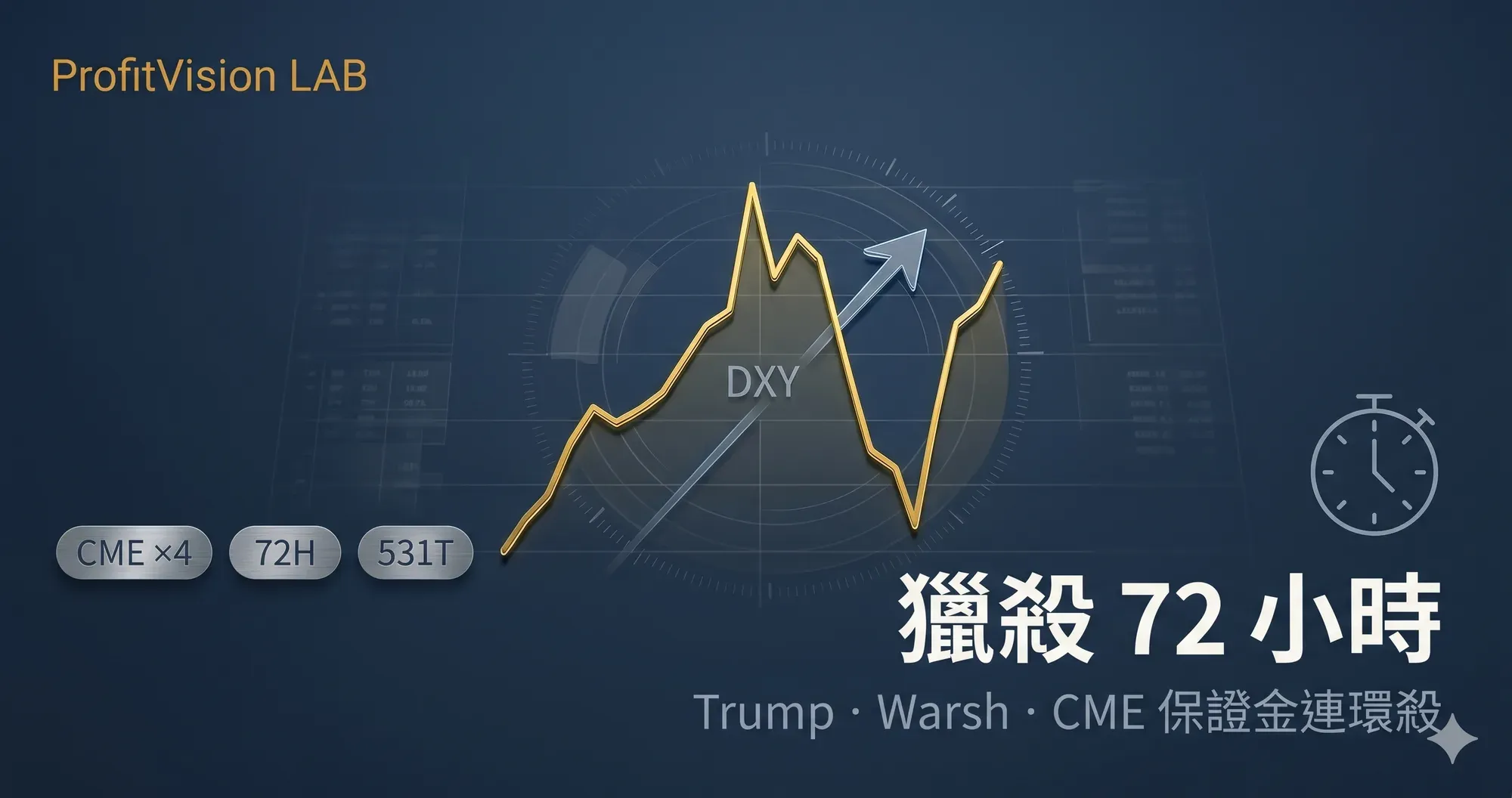
Hunted in 72 Hours
Trump, Warsh, and a Premeditated Futures Massacre
From January 28 to 30, 2026, the gold and silver futures market completed a textbook trap in 72 hours —
from the "weak dollar" bait to the Warsh nomination reversal, from consecutive CME margin hikes to Shanghai suspending buy orders.
This wasn't luck. This was design.
— Shiba the Disciplined, former futures-exchange staff member
This article is the consolidation and conclusion of a four-part Vocus series. It documents a real market event that actually happened, and a trading philosophy that slowly took shape during that period. This isn't hindsight — it's the kind of clarity that only someone who was there at the time, and came out the other side, can put into words.
from bait to the net closing
completed within 6 weeks
mostly paper-gold leverage
that almost nobody was watching
[The Bait] The Sweet Lie of a Weak Dollar
The story begins with a single sentence.
Tuesday, January 28, 2026. In a public setting, Trump signaled that he preferred a weak dollar. The moment the news broke, the algorithms moved first. Gold and silver futures gapped up, program orders finished positioning within milliseconds — while human investors were still reading the headline, the long positions had already piled up.
Emotion came next. Silver ETFs saw their largest single-day inflow in history. An infectious narrative spread across social media: "Silver is about to relive the 1980 squeeze." That year, the Hunt brothers cornered the silver market and drove the price from $6 an ounce to $50, wiping out short sellers within a month. This story spread virally across Reddit and X. Every repost became new long capital.
Here's the physics of FOMO: when a narrative is beautiful enough, it becomes a self-fulfilling prophecy — until it isn't. Over those few days, silver's rally was strong enough to silence any cautious analyst. A trend is a trend — either you get on it, or you watch it go. Many chose the former, and added leverage on top.
On Wednesday, gold approached $2,800 and silver broke through $32. Financial TV brought on analysts who used charts and tone to tell you this was only the beginning. Long positions accumulated simultaneously around the world. That night, plenty of people fell asleep smiling.
[The Net Closes] Warsh, the DXY, and Four Margin Hikes
Thursday, January 30, 2026. Some later called this day "Black Thursday" — not the most precise label, perhaps, but the sentiment behind it was accurate.
In the morning, news broke: Kevin Warsh would be nominated as the next Federal Reserve Chair. Who is Warsh? A hawk. He advocates for a strong dollar. He and Trump's proposed "weak dollar policy" stand in direct opposition. The market answered this news with a single move: the US Dollar Index (DXY) shot up vertically.
Trump's "weak dollar" hint
Algorithms triggered, gold and silver gapped up, long positions began accumulating. Silver ETFs recorded the largest single-day inflow in history.
FOMO heats up, spreads across social media
The "silver relives 1980" narrative goes viral. Retail money keeps pouring in, leveraged long positions peak. Gold approaches $2,800.
Warsh nomination news → DXY shoots up vertically
The dollar index spikes sharply. Gold and silver reverse. Leveraged long positions begin to blow up. CME triggers its first margin hike that same day.
CME hikes margin four times in a row (completed within 6 weeks)
The Shanghai Futures Exchange (SHFE) suspends gold buy orders. Liquidity contracts from both directions at once. 531 tonnes of booked exposure evaporates in the leveraged liquidation.
The instant the DXY spiked, gold and silver reversed almost in sync. Calling the decline "vertical" is not an exaggeration. For anyone holding leveraged long positions, unrealized losses began compounding exponentially within minutes. This wasn't ordinary market volatility — it was a process of long positions being forcibly liquidated en masse, all at once, what's commonly known as a "long squeeze."
Yet the vast majority of longs weren't watching the DXY at all.
They were watching gold. They should have been watching the dollar.
[The Watershed] The Truth Behind 531 Tonnes — The Great Divide Between Paper Gold and Physical Gold
Let's confront this number head-on: 531 tonnes.
This was the "market gold exposure" figure widely cited by financial media during that period. It gives you a sense of something physical — five hundred and thirty-one tonnes of gold. Something heavy, sitting in a vault somewhere. But that instinct is wrong — badly wrong.
531 tonnes was a figure for booked, leveraged long positions — not physical gold. Most of it was "paper gold" held through futures, ETFs, and CFDs — meaning it was gold exposure represented by a piece of paper, a contract, with no equivalent amount of physical gold backing it. When the market reversed, these contracts needed to be liquidated; the pressure of that liquidation is exactly the vertical drop you saw.
| Category | How It's Held | Behavior During the Reversal | Outcome |
|---|---|---|---|
| Paper gold longs | Futures contracts, CFDs, leveraged ETFs | Forced liquidation / stopped out | Contributed to the downward momentum, took unrealized losses |
| Physical gold holders | Physical bars, coins, unleveraged ETFs (like GLD) | No liquidation pressure, free to keep holding | Rode out the volatility, some even added at the lows |
| Options sellers | Selling puts (bullish) or calls (bearish) | Depends on structure design and protective mechanisms | Those with ample margin buffer survived |
The people who didn't get liquidated were the physical gold holders. Their gold's price fell too, but they faced no margin call pressure, and so no forced-liquidation fate. For them, the price drop was just a change in a number on paper, not a real-world catastrophe.
[The Exchange Insider's Perspective] How Margin Is Really Designed
I once worked at a futures exchange. Not for very long, but long enough to understand one thing: margin isn't your cost. Margin is your right to keep breathing in the market.
Most investors have a fundamental misunderstanding about margin. They think of it as fixed — whatever you posted when you opened the position stays that number, as long as the market doesn't move too much. This assumption won't hurt you while the market is calm. When the market moves violently, it can kill you.
How CME Margin Is Really Designed
Every major futures exchange in the world designs margin around the same principle: the expected volatility of the underlying over a specific future window. This isn't a fixed amount — it's a dynamic figure that can be adjusted at any time as market volatility changes.
CME (the Chicago Mercantile Exchange) uses the SPAN (Standard Portfolio Analysis of Risk) system. At its core, it calculates: under the worst-case scenario, how much could this position possibly lose over the next trading day? That "worst-case scenario" is calculated dynamically based on current market volatility.
In other words: when the market is moving violently, CME can raise margin requirements multiple times within a single trading day. This isn't an exception — it's the system working as designed. On January 30, 2026, CME did in fact activate this hiking mechanism; and over the following six weeks, gold futures margin was raised a total of four times.
From the exchange's perspective, this is a risk-management tool — preventing a chain reaction of liquidations from overwhelming the entire clearing system. From the perspective of a long trader receiving the margin call, it's a knife driven in exactly when you're at your weakest.
What's more brutal is that CME margin hikes tend to happen at the moment of maximum chaos — exactly when you have the least spare cash to post. On January 30, 2026, within hours of the Warsh nomination news breaking, long accounts had already started receiving margin call notices. Traders without sufficient buffer capital had no choice but to accept the loss and exit. And every forced liquidation became ammunition for the next wave down.
The Shanghai Futures Exchange (SHFE) suspending gold buy orders during the same period cut off liquidity from the other direction. What longs needed was someone willing to take the other side of their position; SHFE's suspension closed off that escape route too. With pressure applied from both East and West simultaneously, the liquidation of long positions became a one-way street.
[The Conditions for Survival] Three Principles That Keep You Alive
The people who made it through that period, once it was over, turned out to share some common traits. This isn't hindsight — these were things these people were already doing before the massacre even began.
Watch the dollar index (DXY / UUP) — not just gold
The fate of precious metals isn't decided by the supply and demand of precious metals themselves. At least in the short run,
it's decided by dollar strength. The DXY is the upstream signal for gold's direction.
In this event, the DXY changed direction hours before gold reversed —
that was the only escape window, but you had to already know where to look.
When holding a gold or silver position, UUP (the dollar ETF) should always be on your second screen.
The 10x margin rule: this is what "breathing normally" actually means
The right way to measure whether you can withstand margin volatility isn't "how much margin have I posted right now" — it's whether your available cash can cover 10 times the current margin requirement. Sounds conservative? Under a regime where CME can raise margin multiple times in a single day, this isn't conservative — it's the bare-minimum margin of safety. Below 10x, you're not trading — you're gambling, and in a game where the house can change the rules at any moment.
Cash is your right to survive — not "idle capital losing out on opportunity cost"
The biggest mistake many traders make is treating the cash sitting in their account as "money that isn't working." This mindset pushes you to over-deploy capital at the wrong moments just to "put your cash to work." In a violently volatile futures market, cash is the ammunition you use to post a margin call, the confidence that keeps you from being forcibly liquidated, and the dry powder that lets you add aggressively when everyone else is getting wiped out. Cash isn't a sunk opportunity cost. Cash is your right to keep breathing in this market.
and they didn't know about Warsh any sooner.
They survived because they still had cash on hand.
[The Origin of the Four-Layer Screen] How This Event Changed My Trading Methodology
It was after that period that I started seriously thinking about "filtering."
Before that, my trading logic went roughly: find a convincing thesis, build a position, manage the risk. That sounds reasonable, but it had a fundamental flaw: I spent far too much time analyzing "why this is worth doing," and far too little time thinking about "under what conditions is this even allowed."
The events of January 2026 made one thing painfully clear to me: the market is full of trades that "make logical sense but are simply not allowed given the risk structure." The bullish thesis on gold and silver wasn't false at that moment — the weak-dollar expectation was real, silver's fundamentals were real, and the FOMO was real too. The problem was that none of those arguments answered the single most important question: if your read is correct, but the timing arrives three months later than you expected, can your account survive those three months?
That's the starting point behind the design of the Four-Layer Defensive Screen: not to help you find more opportunities, but to help you filter out the opportunities you can't survive long enough to cash in on.
| Filter Layer | Core Question | Applied to Gold in January 2026 |
|---|---|---|
| Layer 1: Fund Flow | Is smart money entering or exiting? | Institutional short positions kept rising — already a warning sign |
| Layer 2: Moat | Can the underlying's fundamentals hold up while you wait out the volatility? | Precious metals generate no cash flow, so there's no fundamental anchor for the position |
| Layer 3: Volatility | Can margin pressure under the current IV environment be tolerated? | IV spikes → CME hikes margin → the direct killer |
| Layer 4: Technicals | Does the entry point and structure leave room for error? | Chasing the price at the top, with no margin for error |
Every one of these four filters was something that event taught me. They're not theoretical best practices — they're survival rules extracted from an actual market massacre.
You're free to disagree with my trading logic, and to think this kind of framework is too conservative, that it leaves too few opportunities on the table. But before you build your own system, I want to ask you one question first:
If today were January 30, 2026, would your account survive?
If your answer is "I'm not sure," then you need a system more than you think you do. Not a prediction system — a survival system.
For the complete breakdown of the Four-Layer Defensive Screen, see "The Four-Layer Defensive Screen for Options Trading" (coming soon);
for the stock-qualification evaluation process, see "From Moat to Margin: A Complete Framework for Evaluating a Stock" (coming soon).