Delta Electronics (2308): A Five-Layer Transparency Framework Deep Dive | The Valuation Test for an AI Power Tollbooth
When an AI data center consumes ten times the power of a traditional server room, the bottleneck is no longer the chip -- it is the power. Delta Electronics is standing right at the center of that bottleneck.
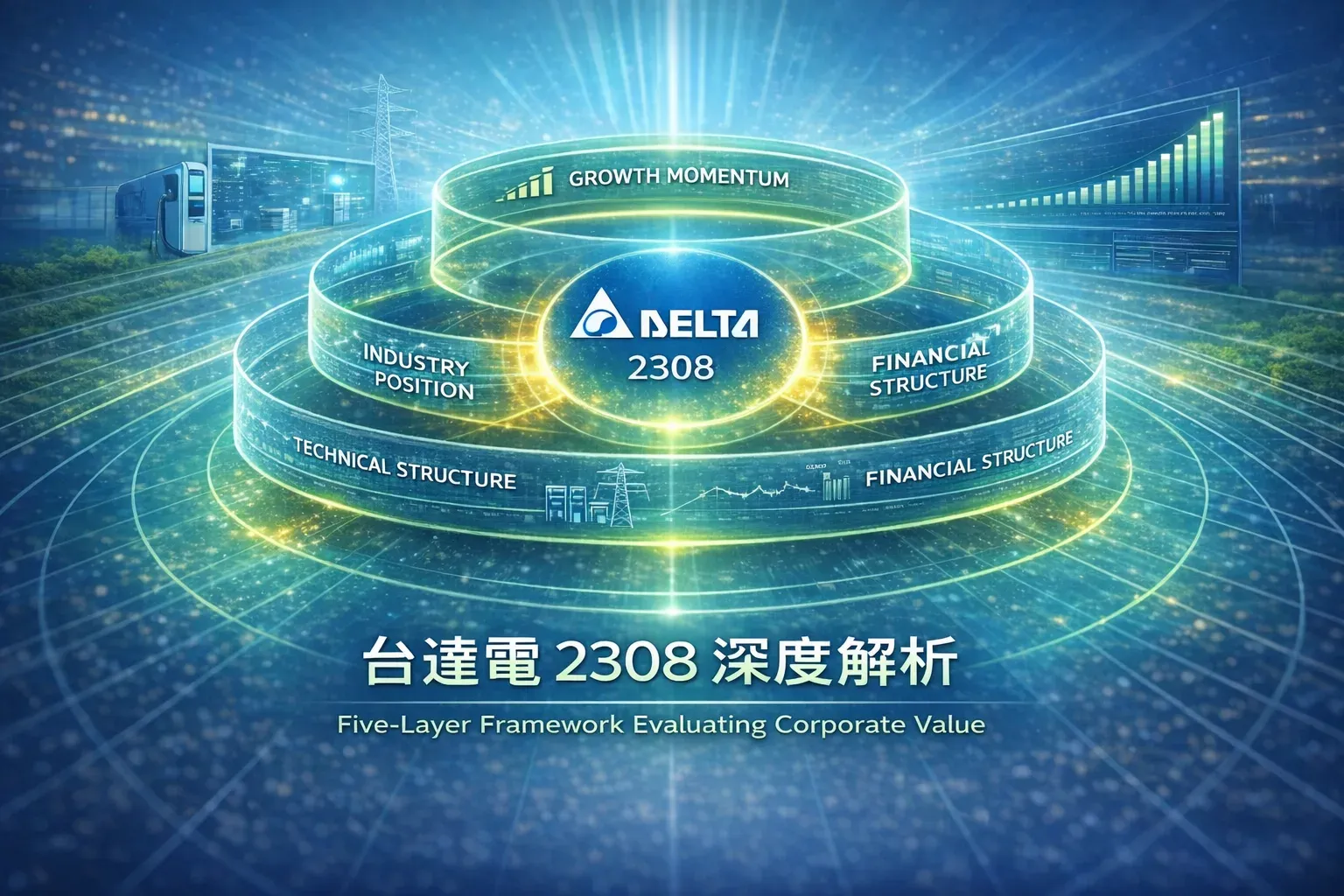
Delta Electronics (2308): A Five-Layer Transparency Framework Deep Dive
2025 EPS: NT$23.14 (+71% YoY) | 2026E EPS: NT$35.95-46 (wide analyst divergence)
Moat: Power PSUs + liquid-cooling CDUs + HVDC Power Racks, all three combined | Risks: optimistic valuation, Thai Delta's tax rate, dilution of liquid-cooling market share
Conclusion: A good company, but not necessarily a good price. What you're buying right now is the 2027 story.
Layer One: Track Positioning — Power Is the Tollbooth on AI's Last Mile
The AI compute arms race has moved on from "whose chip is faster" to "who has enough power." This isn't a metaphor — it's a physical constraint.
Every new generation of NVIDIA's GPU platform draws more power: the GB200 rack's power needs are mainly met with 5.5kW PSUs, and the Vera Rubin (VR200) generation arriving in the second half will see the wattage of a single power module jump to 12kW or even 18kW, an increase of 2.5 to 3x in content value over GB300. This isn't just a number changing — it means the power architecture of the entire data center must shift from traditional AC to high-voltage DC (HVDC), and from air cooling to liquid cooling.

The timescale of this "great power migration" is a structural transformation on the order of five to ten years, not a two- or three-year business cycle. Delta Electronics Chairman Ping Cheng put it bluntly: building an AI data center takes two years, but building a power grid can take five years or longer.
On this track, Delta's role isn't that of a passive beneficiary of volume production — it's a spec-defining, critical-bottleneck supplier. It spans three core nodes: power supply (PSUs, DC/DC converters), thermal management (liquid-cooling CDUs, cold plates, manifolds), and power architecture upgrades (HVDC Power Racks, BBU backup batteries, solid-state transformers).

Layer Two: The Business Moat — Could a Rival Replicate It With Three Years and Three Times the Resources?
Technical Barrier: A "Cutting the Corner" Advantage From a Decade of EV Technology
Delta's most underrated moat isn't its current AI power market share — it's the power-conversion technology it accumulated over the past decade in EV charging.
The solid-state transformer (SST) is the best example. This is core technology Delta developed years ago when it invested in EV charging, with energy conversion efficiency now reaching 98.5%. At the time, the market mocked it as "burning money," yet today it's become a key component of the HVDC architecture in AI data centers. Ping Cheng once responded calmly: "The technology had already claimed its position." This kind of cross-domain technology migration is something a pure AI-concept stock simply can't do.
In the HVDC generation, Delta doesn't just ship PSU components — it also integrates PSUs, BBUs (backup batteries), and supercapacitors, assembling them into complete Power Racks for shipment, upgrading its operating model from component supplier to systems solution provider. The technical barrier for this transformation is extremely high — it isn't something you can achieve by drawing a diagram; it's the accumulation of decades of power-electronics engineering experience.
Customer Lock-In: The Stickiness of Design-Ins
The power supply in an AI server isn't something you swap out casually. Once it's designed into a cloud giant's bill of materials, the design-validation cycle runs 12 to 18 months. Delta's AI server power supplies now account for nearly half of its server-business revenue, and it leads globally in high-power power-module market share.
But the moat has cracks too. Delta itself admitted on an earnings call that competitors are starting to emerge in liquid cooling, and customers want to diversify their supplier base. This is a signal growth-stock investors need to take seriously — the ceiling on market share may arrive sooner than expected.
Vertical Integration: A Structural Cost Advantage
Compared to its main competitor Vertiv, which focuses on whole-room solutions but sources components externally, Delta's strength lies in in-house manufacturing across the entire chain — from power modules, fans, and thermal components to full system integration. This gives Delta a structural advantage in cost control.
Management Quality: A Rare Success Story in Family Succession
Founder Bruce Cheng founded Delta in 1971, and after retiring in 2012 didn't hand the reins directly to his son — instead, professional manager Yancey Hai served as chairman while Ping Cheng first served as CEO for 12 years, only formally taking over as chairman in 2024. Ping Cheng joined Delta in 1988 and worked his way up starting from a Thai factory floor position, over 36 years of experience. Internally, Hai has been described as a "regent" figure. This model — "use a professional manager to bridge the transition, then let the second generation take over on the strength of a proven track record" — is extremely rare in Taiwan's tech industry.
Layer Three: Financial Health — Do the Numbers Tell the Same Story as the Rhetoric?
The Growth Triangle
Monthly Revenue Momentum: March 2026 revenue was NT$59.78 billion, up 19.81% month-over-month and 37.6% year-over-year, an all-time monthly high. Cumulative Q1 revenue was NT$159.353 billion, up 34% YoY. Revenue share across the four business segments: Power Electronics & Components 53%, Infrastructure 33%, Automation 9%, Mobility 5%.
EPS Growth Momentum: full-year 2025 EPS was NT$23.14, up 71% YoY, nearly doubling from 2024's NT$13.56.
Revenue Mix Shift: the share of data-center-related revenue has risen from about 40% in 2025 to an estimated 50% in 2026. Server power supply revenue is projected to grow about 70% YoY to NT$230 billion, and liquid-cooling revenue is projected to grow 140% YoY to NT$120 billion.
Earnings Quality (With Peer Comparison)

| Metric | Delta (2308) | Lite-On (2301) | Notes |
|---|---|---|---|
| 2024 Gross Margin | 32.4% | ~22% | Delta's vertical integration advantage is clear |
| 2025 First Three Quarters Gross Margin | 34.14% | 23.3% | The gap widens to nearly 11 percentage points |
| 2025 Q3 Gross Margin | ~37% | 25% | Delta's single-quarter all-time high |
| 2025 First Three Quarters Operating Margin | 14.62% | 9.9% | Delta is nearly 1.5x Lite-On's level |
| 2025 Full-Year EPS | NT$23.14 | ~NT$6.7 | Delta's profit scale dominates |
| P/E (2026E) | 45-48x | ~22-25x | Delta commands a premium, but is still below the electronic components industry average of ~61x |
| R&D Spend as % of Revenue | ~9% | ~5% | R&D investment intensity is far higher than peers |
This set of data reveals a critical fact: even though Delta and Lite-On are both classified as "power supply" companies, they're no longer in the same profitability tier. Delta's gross margin of over 34% is closer to the level of semiconductor equipment or high-end industrial electronics, not traditional electronic components.
Operating Margin: Delta's net operating margin over the first three quarters of 2025 jumped to 14.62%; Q3 alone reached 16.5%, equivalent to earning about NT$270 million a day. This speed of operating-margin expansion is extremely rare among Taiwan's large-cap electronics manufacturers.
ROE Trend: annualized ROE is estimated at around 25-28%, a major improvement from about 15% in 2024 — placing it among the top tier of Taiwan's electronic-components stocks.
Capex Intensity: 2025 capex was about NT$46.1 billion, with Thai Delta alone accounting for about NT$16.5 billion, plus roughly NT$2.7 billion for three new plants in India. The group's total capex remains above NT$40 billion, near its historical high.
Full-Year 2025 Financial Summary: revenue of NT$554.885 billion, up 31.8% YoY; after-tax net income of NT$60.108 billion, up 70.6% YoY. Revenue, gross profit, operating profit, and after-tax earnings all set new records.
Layer Four: Ownership and Market Structure
4-A Foreign vs. Local Institutional Views — Foreign Investors Say Add, but Not Entirely in Sync
| Date | Foreign Institution | Price Target | EPS Estimate | Rating |
|---|---|---|---|---|
| 2026/01 | Morgan Stanley | NT$1,638 | — | Overweight (Top Pick) |
| 2026/01 | Macquarie | NT$1,600 | — | Outperform (Raised) |
| 2026/01 | JPMorgan | NT$1,400 | — | Overweight |
| 2026/02 | FactSet (20 analysts) | NT$1,575 | NT$35.95 (median) | — |
| 2026/04 | US Foreign Broker (Latest) | NT$1,976 | — | Recommend Overweight |
| 2026/04 | Local Broker (Most Bullish) | NT$1,890 | NT$46 | Buy |
The Key Point of Divergence: the gap in EPS estimates. FactSet's median of NT$35.95 vs. the most bullish local estimate of NT$46 — a gap of 28%. The divergence centers on the timing of HVDC revenue contribution, liquid-cooling market share, and the Vera Rubin shipment schedule.
Ownership Flow Rhythm: on April 7, foreign investors were net buyers of Delta, ranking second on the Taiwan market (behind only TSMC). But on January 23, when the stock hit a high, foreign investors were net sellers of 1,424 lots in a single day. This is a classic pattern of "foreign investors betting on the 12-18 month structural story, while not ruling out short-term profit-taking."
4-B Insiders — The Cheng Family's Hand and Thai Delta's Structural Issue
Board and Supervisor Ownership: 7.32%. Bruce Cheng (founder), Ping Cheng (chairman and CEO), An Cheng (director / president of Thai Delta), and Yancey Hai (former chairman, still a director), plus five independent directors (including Sino-American Silicon chairwoman Hsiu-Lan Hsu), for 12 seats total. The Cheng family controls the company through direct holdings, investment vehicles, and foundations — its actual influence exceeds what appears on paper.
Delta holds about 62.16% of Thai Delta. Thai Delta's 2025 revenue was THB 198.1 billion with net income of THB 24.8 billion; in February 2026 its market cap broke $100 billion (THB 3 trillion), a first in Thai history.
But Thai Delta's gross margin is only 28-29% (below the parent company's 35%), because it must pay the parent a 9-10% technology licensing royalty. R&D spending is just 3% of revenue, far below the parent's 9%.

The Four Blows That Cut Thai Delta's Stock in Half in 2025:
| Factor | Specifics | Degree of Impact |
|---|---|---|
| Valuation Bubble Bursting | P/E exceeded 90x, the AI story was priced far ahead of the fundamentals | Main Cause |
| Earnings Miss | Single-quarter profit fell 78% YoY, higher costs + a drag from the EV business | Catalyst |
| Index Weight Cap | The Stock Exchange of Thailand considered restrictions because Thai Delta's weight in the SET index became too large (~17%) | Structural |
| Expected Tax Rate Hike | The effective tax rate could rise from 3-5% to 15% under the global minimum tax | Long-Term Pressure |
But once AI data-center orders materialized, Thai Delta more than doubled from its April 2025 low, and its market cap broke $100 billion again in February 2026. The lesson for Delta investors: Thai Delta's round-trip of being cut in half and then doubling is a perfect demonstration of the risk of "the valuation running too far ahead of the fundamentals." This script is the best cautionary tale for the parent company, Delta, which currently also trades at an elevated P/E.
Thai Delta's Five-Layer Impact: profit contribution (consolidated into the parent's financials) → tax risk (3-5% could rise to 15%) → a capacity-expansion platform (NT$16.5 billion in capex) → tariff risk (the US accounts for 35% of revenue, and the 19% tariff can be passed through) → valuation distortion (the subsidiary's P/E of 94x exceeds the parent's 48x).
4-C Retail Positioning and Market Sentiment
The stock has been placed on the exchange's "attention" watch list. The mainstream market narrative: "the TSMC of AI power." The fragile assumption: an AI capex-cycle slowdown, or HVDC-spec adoption coming in slower than expected.
Layer Five: Valuation Anchors and Scenario Analysis
Current Valuation
| Valuation Basis | EPS | Implied P/E | Read |
|---|---|---|---|
| Trailing (2025 Actual) | NT$23.14 | 75x | Elevated |
| Forward (FactSet Median) | NT$35.95 | 48.3x | Slightly Above Reasonable |
| Forward (Local Bullish Case) | NT$46 | 37.7x | Reasonable If It Materializes |
| Forward (2027E) | NT$54.8-63 | 27.5-31.7x | Back to the Historical Average |
Historical reference: Delta's average P/E range over the past several years has been 22 to 30x.

If you're only willing to pay for confirmed earnings, wait for the Q2 earnings call to confirm three conditions:
① Whether AC/DC power supply shipments ramp up as scheduled in Q2
② Whether liquid-cooling market share holds its position as the largest supplier
③ Whether gross margin can hold stable above 35%
Conclusion
Is Delta Electronics a good company? Without a doubt. It stands at the crest of the structural wave of AI electrification, holds a moat built from a decade of accumulated technology, has a credible management team, and its financial data aligns closely with its growth narrative.
But a good company doesn't equal a good price. At the current share price, what you're buying isn't "what Delta looks like now," but "what Delta should look like two years from now." That gap is the valuation risk.
This isn't saying "don't buy it." It's saying: anyone buying Delta at NT$1,700 must be clear that they're buying the bullish scenario, and must be mentally prepared to absorb a 15% to 25% pullback if the market reverts to the base case.
Think with me, not just trade with me.