Approved Assets List v1.0 (The Touchable List)
This isn't a stock-picking list — it's a personality-compatibility list, defining exactly which assets are structurally incapable of destabilizing your life. Three white-line screening principles, a five-tier asset classification (A Stability through E Hedging), and six Do Not Touch red lines form a complete boundary system for investing, so every entry no longer requires a fresh decision.
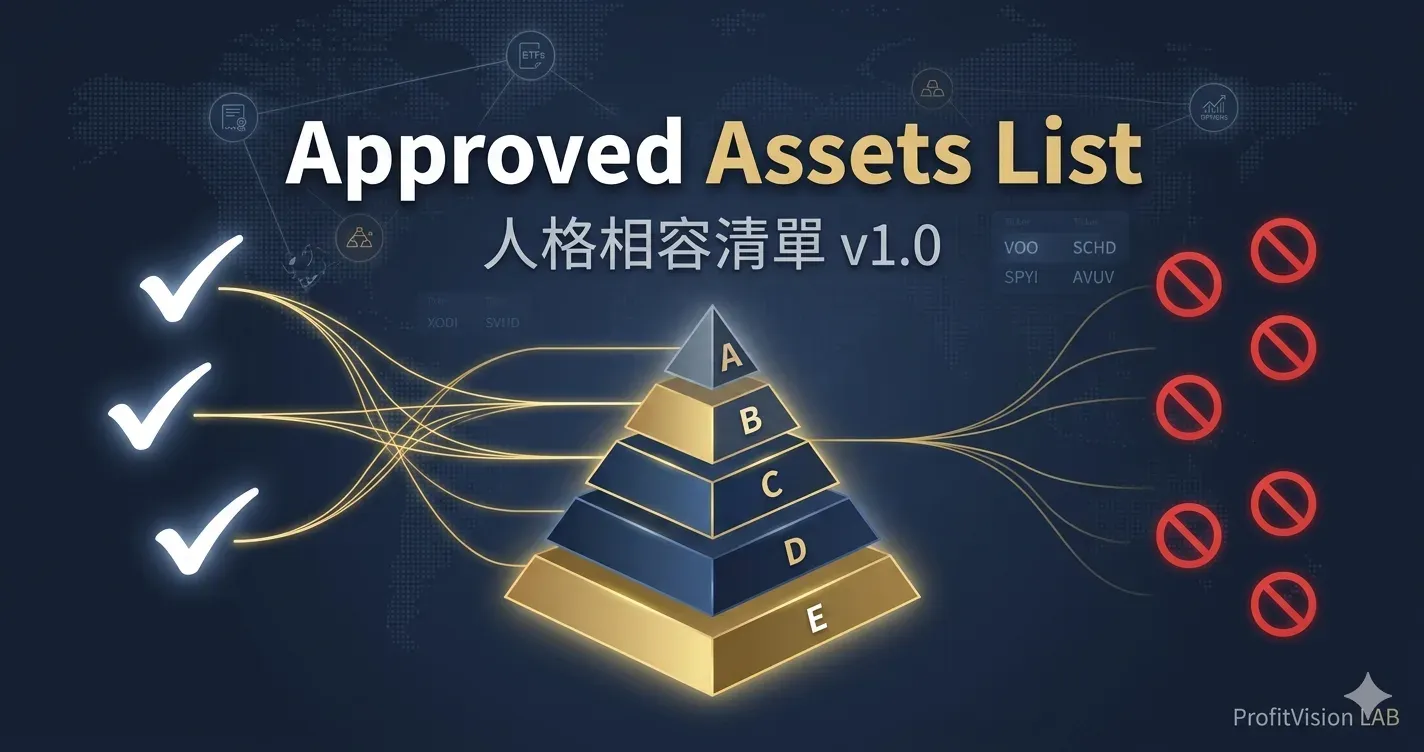
Approved Assets List
The Touchable List
This list does not exist to tell me "what will make money." It exists to clearly define which asset types, by structure, "will not destabilize my life" — even if they lose money in the short term, they will never pull me back into losing control. This is a personality-compatible list, not a market-prediction list.
1. Purpose of the System (More Important Than Stock Picking)
Many investors spend most of their time on "stock picking" — which name will go up, which sector has an opportunity, whether this quarter's earnings will beat expectations. But before any of that, there is a more fundamental question almost no one ever asks:
"Is this asset type structurally compatible with my life? Even if I lose money, will it not send me spiraling out of control?"
The Approved Assets List was not designed to make you more money — it was designed to keep every investment you make inside your "personality boundary." No matter how promising an asset outside that boundary looks, it is off-limits.
2. Core Screening Principles (The Three White Lines)
Only assets that satisfy all three of the following at the same time qualify for the Approved Assets List:
Rule: as long as an asset satisfies all three white lines at the same time, it is treated as a "structurally compatible asset" and may be added to the whitelist.
If it fails even one, no matter how tempting the opportunity, entry is strictly prohibited.
3. Approved Assets List v1.0 (Official Classification)
On SCHD: A curated selection of high-quality dividend payers (strong free cash flow, long records of consecutive dividend growth). Because the underlying fundamentals are solid, drawdowns during bear markets are meaningfully smaller than the broader market, making it a core tool in Layer A that combines defensiveness with income. The 20-year Treasury bond (TLT) is no longer included in this layer, because in a volatile-rate environment its correlation with stocks runs too high and its protective effect is unreliable (long-duration hedging needs are addressed in Layer E instead).
On SPYI: The NEOS S&P 500 High Income ETF generates 12%+ annualized income using a put-spread overlay strategy; it is an open-ended ETF with ample liquidity. JEPI / JEPQ are held in this layer purely for "income stability" and are not used for options trading here (their options-trading function belongs to Layer C).
On JEPI / JEPQ: In this layer they are used for "active options strategy" purposes (ELN structures combined with monthly cash flow), which differs from their positioning in Layer A as "passively held for dividend income" — the same underlying can serve different purposes across different layers.
Single-position cap: ≤ 5% of total assets
Stop-loss line: -7% (no discussion, no waiting, no holding out)
Never average down · Never hold and hope · Wait at least 3 days after a stop-loss before revisiting
On ADVD: Serves as a multi-factor defensive allocation, diversifying and hedging risk through different risk-premium factors with lower correlation to the equity market, reducing the overall portfolio's dependence on any single market regime — when the equity market's risk premium collapses broadly, assets tied to different factors do not necessarily move down in lockstep. It replaces the previously used SVOL (a short-volatility strategy ETF) — during market crashes, volatility spikes sharply, and SVOL's actual protective effect ran opposite to what was expected; in theory a hedging tool, in practice it behaves more like a risk asset.
4. Do Not Touch Red Lines (These Cannot Be Touched)
The whitelist defines what you "can touch," but it is equally important to clearly define what you "will never touch." If any of the following is breached, no matter how compelling the justification, entry is strictly prohibited:
5. Hard Caps on Position Allocation (Non-negotiable)
The following limits apply under any market condition and do not loosen just because "the opportunity is too good":
| Asset Layer | Type / Role | Layer Cap | Notes |
|---|---|---|---|
| A Core Stability Layer | Life foundation | 30–40% | Must never be reduced in order to add to other positions |
| B Core Growth Layer | Passive compounding | 20–35% | Held long-term, not actively traded |
| C Options Strategy Layer | Cash-flow engine | 15–25% | Entry only after passing the Four-Layer Defensive Screen |
| D Swing Growth Stocks | Asymmetric opportunities | ≤ 15% single name ≤ 5% | Strict -7% stop-loss, no exceptions |
| E Defensive/Hedging Layer | Black-swan protection | 5–10% | Exists for survival, not for return |
Each layer's percentage is a "recommended ceiling," not a fixed value — A+B form the core anchor (combined 50–85%), while C+D+E fill the remaining allocation. It is normal for the sum of all layer caps to exceed 100%: each cap represents "the ceiling for that layer," not a requirement to fill every layer. When cash is abundant, it is better to let A+B run high than to force capital into Layers C and D.
Layer D combined must not exceed 15% of total assets, and no single position may exceed 5%. The -7% stop-loss line is non-negotiable — "this time is different" is always how a stop-loss gets bypassed. "Certainty" is risk control's biggest enemy.
6. Three Mandatory Self-Checks Before Placing an Order
Before pressing confirm on any new entry, it must pass all three of the following questions at once:
These three questions are not "technical analysis," and they are not "fundamental research" — they ask something else: is this trade compatible with your system? Is it compatible with your life? An opportunity that isn't compatible with your system, no matter how good it looks, is not your opportunity.
7. Closing Statement on the System (What the Whitelist Really Means)
This Approved Assets List does not exist to limit my pursuit of growth — it exists to make sure I only participate in the market in ways that "will not damage the stability of my personality."
With this list in place, I no longer need to ask, every time a new opportunity comes along, "is this time different?" — that question will always make you waver in the face of temptation.
I only need to ask one question:
"Is it on the whitelist, or the blacklist?"
Whitelisted assets get traded by the rules. Blacklisted assets are off-limits, no matter how good the opportunity looks. The power of a rule lies in the fact that it never needs to be decided again.
I'm going to survive by never doing anything stupid, for the rest of my life.