Vertiv (VRT) Q3 2026 Earnings Update: Growth Remains Strong as Markets Reassess the Future
Vertiv's third-quarter fundamentals remain strong, but power, financing and construction constraints could slow industry growth. We examine valuation, cash flow and UIG acquisition returns from a moderately bearish perspective.
Vertiv's third-quarter revenue rose 61% year over year, GAAP operating profit increased 90%, and organic orders grew by more than 100%. The company also raised its full-year outlook. Yet the shares closed at $205.55 on November 4, down 12.9% for the day and 45.9% below their 52-week intraday high. The results show a company still growing rapidly, while the share price reflects investors' concerns about the pace and returns of future AI infrastructure development.
Our view is moderately bearish. Demand for data center power and cooling still has room to grow, and Vertiv's long-term competitive position remains favorable. Power availability, financing, approvals and customers' returns on investment, however, may limit the industry's actual pace of expansion. Even if Vertiv continues to grow, its valuation could remain under pressure if growth falls short of earlier expectations. At the midpoint of the company's full-year adjusted EPS guidance, the November 4 share price was approximately 28.7 times earnings; the decline alone does not establish that the stock is cheap.
1. How AI data center demand reaches Vertiv
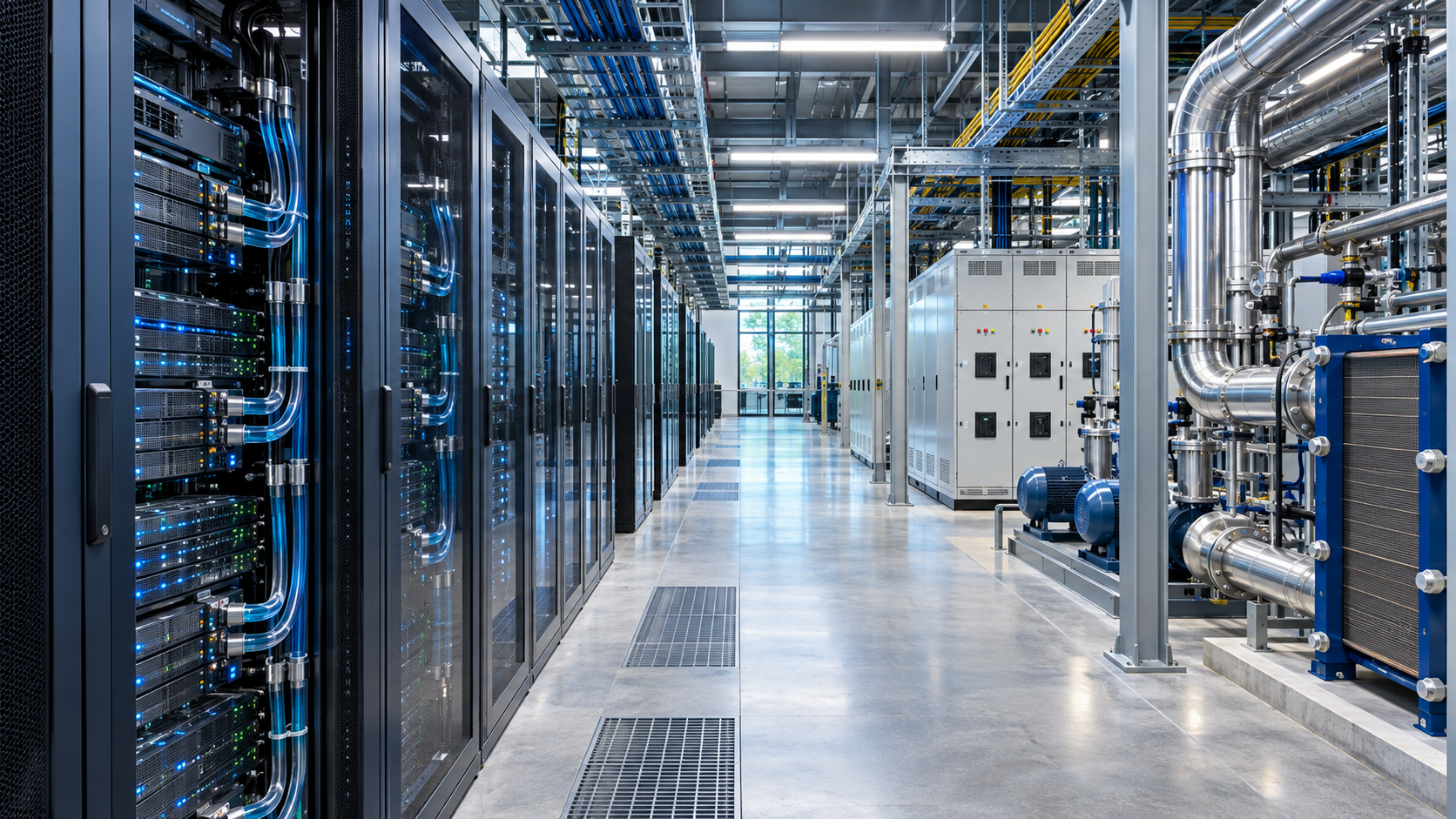
AI servers increase power density per rack and raise the demands placed on cooling, power distribution and backup systems. After purchasing GPUs, a data center must still secure power, install distribution and cooling equipment, and test its systems before bringing computing capacity online. Vertiv supplies power management, thermal management, modular infrastructure and related services at critical points in this chain.
Power and cooling systems must match a facility's design, rack density, electricity requirements and maintenance needs. Reliability also affects whether a data center can continue operating. Customers therefore assess equipment prices alongside integration, delivery speed, service and long-term reliability.
Higher power density does not automatically become Vertiv revenue. Projects can be affected by grid connections, construction approvals, financing and customers' investment schedules. A delayed connection may change equipment delivery dates; higher financing costs may cause some developers to reschedule construction. Long-term demand can remain intact even if expansion takes longer than expected. Vertiv must deliver equipment on time, maintain margins and collect cash.
Third-quarter revenue was $4.313 billion, up $1.637 billion, or 61.2%, year over year. According to the company's non-GAAP reconciliation, organic revenue increased $1.471 billion after excluding currency and acquisition effects, an organic growth rate of 55.0%. Acquisitions added approximately $157 million, while currency reduced revenue by approximately $9.1 million. Organic revenue grew 66% in the Americas, 48% in Asia-Pacific and 19% in Europe, the Middle East and Africa. Demand has translated into deliveries and revenue. Vertiv Q3 2026 earnings release
2. The competitive advantage lies in integration and delivery
Vertiv integrates power, cooling, controls and services. As data center power density rises, customers must coordinate more equipment and engineering requirements. A supplier that participates early in design, completes testing and provides global service can be better positioned for subsequent expansions and maintenance.
This can create switching costs, but Vertiv is not irreplaceable. Schneider Electric, Eaton and Johnson Controls have capital, distribution and engineering capabilities. Customers may retain multiple suppliers to reduce delivery risk and preserve bargaining power. Vertiv must continue to demonstrate value through product efficiency, lead times and service.
Organic orders grew more than 100% year over year in the third quarter. Orders and revenue do not necessarily represent the same period or projects: orders may extend across quarters, and recognition depends on production, construction, acceptance and cancellation terms. The 55% increase in organic revenue shows that previously accumulated demand is translating into current deliveries; it does not mean that this quarter's new orders became this quarter's revenue. The conversion of orders into revenue and cash remains important.
Growth across regions does not eliminate shared exposure. Projects in different countries may still be driven by hyperscalers and AI capital spending. If customers reduce construction, financing tightens or power connections are delayed, orders across regions could slow together. These conditions need not immediately alter Vertiv's competitive position, but they can affect the speed at which demand becomes revenue.
3. Third-quarter earnings show operating leverage
Third-quarter revenue increased $1.637 billion and GAAP operating profit increased $467 million. The increase in operating profit was approximately 28.5% of the increase in revenue, above the prior-year quarter's overall operating margin of 19.3%, consistent with improved operating leverage. The company attributed the rise in adjusted operating margin to operating leverage and manufacturing productivity, partly offset by product mix and investments for growth.
Metric, $ millions unless noted | Q3 2025 | Q3 2026 | Change |
|---|---|---|---|
Revenue | 2,675.8 | 4,312.8 | 61.2% |
GAAP operating profit | 516.7 | 983.8 | 90.4% |
GAAP operating margin | 19.3% | 22.8% | +3.5 percentage points |
Adjusted operating profit | 595.6 | 1,086.9 | 82.5% |
Adjusted operating margin | 22.3% | 25.2% | +2.9 percentage points |
GAAP net income | 398.5 | 764.5 | 91.8% |
GAAP diluted EPS, $ | 1.02 | 1.95 | 91.2% |
Adjusted diluted EPS, $ | 1.24 | 2.21 | 78.2% |
Both GAAP and adjusted figures show improved operating performance. Differences primarily include amortization of intangible assets, changes in the fair value of acquisition-related contingent consideration and transaction costs. Amortization is not a new cash payment in the current period, but the assets had an acquisition cost; contingent consideration adjustments also reflect the economics of existing acquisition commitments. Adjusted figures help assess operations, while acquisition costs remain relevant to shareholder value. Vertiv Q3 2026 Form 10-Q
The company raised its full-year revenue guidance midpoint to $14.65 billion and adjusted EPS midpoint to $7.15, with adjusted free cash flow guidance of $2.6 billion to $2.8 billion. The guidance reflects management's expectation of continued fourth-quarter delivery and profitability; actual shipments and collections remain to be seen.
4. Free cash flow is growing, but expansion requires capital
Third-quarter operating cash flow was $794 million, up 64%, and company-defined adjusted free cash flow was $652 million, up 50%. Capital expenditure rose from $45.2 million to $139.1 million. The company said higher operating profit supported cash flow growth, partly offset by increased working capital and capital expenditure to support growth.
Cash flow metric, $ millions | Q3 2025 | Q3 2026 |
|---|---|---|
Operating cash flow | 482.7 | 794.0 |
Change in working capital | (71.5) | (138.3) |
Capital expenditure | 45.2 | 139.1 |
Capitalized software expenditure | 1.5 | 2.7 |
Company adjusted free cash flow | 436.0 | 652.2 |
Adjusted free cash flow is operating cash flow less capital expenditure and capitalized software expenditure. It excludes acquisition spending and debt principal repayments, so it cannot all be treated as cash available for distribution to shareholders. Adjusted free cash flow for the first nine months was $2.230 billion, close to the full-year guidance range. Working capital used $138.3 million in the third quarter, but provided $540.5 million over the first nine months. The quarterly and year-to-date directions differ; one quarter alone does not establish a deterioration for the year. Vertiv cash flow reconciliation
Inventory rose from $1.457 billion at the previous year-end to $3.288 billion at September 30; accounts receivable rose from $3.109 billion to $4.380 billion. During the first nine months, inventory and receivables together used $3.091 billion of cash, while accounts payable and deferred revenue together provided $3.722 billion. Deferred revenue rose from $1.815 billion to $4.121 billion, representing consideration received or due before performance obligations are fulfilled. It supported cash flow and also represents an obligation to deliver. If new orders slow and deferred revenue stops rising, the company must still manage accumulated inventory, receivables and fixed costs.
5. UIG expands capabilities and raises the return hurdle
After the quarter ended, Vertiv completed its acquisition of Utility Innovation Group for approximately $1.45 billion in upfront cash, with up to another $1.15 billion in contingent cash consideration. According to the company, UIG's microgrid, on-site generation coordination and behind-the-meter power capabilities are intended to help customers reduce delays associated with utility grid expansion. The acquisition extends Vertiv's offering from power and cooling inside the data center toward a broader power-up solution. Vertiv announces completion of the UIG acquisition
A plausible strategy does not by itself establish a reasonable price. The upfront consideration was approximately 13 times UIG's expected 2027 EBITDA, based on earnings that have yet to be realized. Contingent payments are linked to EBITDA targets, but the ultimate return depends on UIG's actual incremental operating profit and cash flow and the total consideration paid. Cross-selling, project cash flow and returns on invested capital deserve attention.
At September 30, Vertiv held $3.513 billion in cash and $199 million in short-term investments, before paying for UIG. Fourth-quarter reporting will first show the post-payment cash, debt and working capital position.
6. How will the market price a move toward normalized growth?
VRT closed at $205.55 on November 4, 2026, down 12.9% that day and 45.9% below its 52-week intraday high of $379.94. The share price has fallen substantially, but that comparison alone does not establish how much its valuation multiple has changed, whether it is cheap or whether the decline is over. VRT November 4 price and 52-week range
Market concerns center on the timing and cost of industry construction. Some data center developments rely on external financing, and higher funding costs can delay projects. Grid connections and local approvals may also constrain construction. For Vertiv, delays could push equipment revenue and collections into later periods after the company has already invested in inventory, capacity and acquisitions. Several data center infrastructure stocks fell on November 4, indicating that selling was not confined to Vertiv; simultaneous declines do not establish identical causes. November 4 data center stock moves
Dividing $205.55 by the company's $7.15 full-year adjusted diluted EPS guidance midpoint gives a simplified price-to-earnings ratio of approximately 28.7 times. This uses management's non-GAAP full-year forecast, not historical GAAP earnings or a 2027 estimate. Investors must judge whether future earnings growth and cash recovery support that multiple. If growth slows, the multiple may also fall: the stock can remain flat or decline even as EPS rises.
Analysts disagree. Following the results, an Oppenheimer analyst said they strengthened the case for the company's execution. Bernstein maintained an Outperform rating on November 3, arguing that political risk to US data center construction may be overstated. GLJ Research maintained a Sell rating on November 2 and reduced its target from $188 to $187. These views illustrate different assessments of growth and risk; price targets are not guarantees. Oppenheimer's post-earnings comment, Bernstein on construction risk, GLJ Research rating
Our moderately bearish view focuses on a potential shift from high-growth stock pricing toward the valuation of a more mature business. As growth expectations decline, investors may place greater weight on sustained earnings, cash flow and returns on invested capital, and pay a lower multiple for distant growth. This resembles a shift toward blue-chip valuation, but Vertiv's organic revenue is still growing 55%; it is too early to conclude that the company has reached maturity. The timing and extent of any normalization require further financial results.
In a positive scenario, power and financing constraints ease, orders are delivered on schedule, customers adopt UIG's capabilities, and operating profit and free cash flow continue growing. In a neutral scenario, demand persists but project timelines lengthen and growth normalizes; a lower multiple could offset EPS growth. In a negative scenario, financing or power connections delay projects, leaving inventory and fixed costs at Vertiv as the market reduces growth expectations and valuation. These scenarios illustrate possible directions, not share-price forecasts.
Conclusion
Vertiv's third quarter shows AI data center demand translating into revenue and profit: revenue rose 61%, GAAP operating margin reached 22.8%, and adjusted free cash flow was $652 million. Organic orders grew more than 100%, indicating strong customer demand. Power and cooling are essential to data center operations, and Vertiv's position in integration, delivery and service remains favorable over the long term.
The speed of construction also depends on power connections, financing, approvals and the cost customers are willing to accept. These constraints can extend delivery and collection timelines even if demand remains. Vertiv has increased inventory and capacity and acquired UIG; slower projects could lengthen the time needed to recover that investment. Working capital provided cash overall in the first nine months, supported by rising deferred revenue, and the durability of that support warrants monitoring.
We remain moderately bearish on the stock and the expectations embedded in its price. The market may gradually place less value on rapid growth and assess Vertiv more like a mature business, emphasizing earnings, cash flow and returns on capital. The company is still growing rapidly, so it is premature to declare it a mature blue chip. If growth normalizes and the valuation multiple falls, however, rising EPS may not be enough to lift the stock.
At the November 4 close of $205.55 and the company's $7.15 adjusted EPS guidance midpoint, the simplified P/E was approximately 28.7 times. A lower share price reduces the price investors pay; whether the multiple is reasonable depends on the duration of growth and how much profit becomes cash flow per share. The calculation uses a non-GAAP company forecast and is not a conclusion about future value.
Four questions deserve continued attention: can customer projects be built and delivered on schedule; can revenue grow while margins hold; how will inventory, receivables and deferred revenue affect cash flow; and will UIG's incremental earnings and cash flow justify total investment? If deliveries remain strong, free cash flow per share grows and acquisition returns make tangible progress, the moderately bearish view should be reassessed. Continued delays, higher capital tied up in operations or weaker acquisition returns could extend valuation pressure.
Frequently asked questions
What does Vertiv do?
Vertiv provides power, distribution, cooling, modular equipment and maintenance for data centers and other critical infrastructure. Higher AI rack density requires customers to reconsider power delivery, backup and cooling. Vertiv helps integrate equipment and maintain operations, but competes with companies including Schneider Electric and Eaton; customers may use multiple suppliers.
Why did VRT fall after strong earnings?
Investors must evaluate growth over coming years, not just one quarter. They are considering financing, grid connections and construction timelines, as well as Vertiv's spending on capacity and acquisitions. These are possible influences on expectations; price movements alone cannot establish each factor's contribution to the decline. Strong third-quarter operations do not establish that every future project will proceed on schedule.
Does a 45.9% decline from the high mean the stock is cheap?
The decline shows that the price is below its high, not whether it is undervalued. At the November 4 close and the midpoint of full-year adjusted EPS guidance, the simplified P/E was approximately 28.7 times, based on a non-GAAP forecast. Investors must assess future growth, cash conversion, acquisition returns and risk. The 52-week intraday high is not necessarily a measure of fair value.
Why can the share price fall while the company grows?
The share price depends on both earnings per share and the multiple investors pay. Illustratively, if adjusted EPS grows 20% from $7.15 to $8.58 but the P/E falls to 22 times, the calculated price is approximately $188.76, below $205.55. This is arithmetic illustrating valuation compression, not a forecast of EPS, a fair multiple or the stock price.
Has Vertiv already become a blue-chip stock rather than a growth stock?
That conclusion would be premature. Third-quarter organic revenue grew 55%, and the midpoint of fourth-quarter organic growth guidance was approximately 50%. A shift toward blue-chip valuation describes a possible future path: as growth normalizes, investors may emphasize stable earnings, cash flow and capital returns and pay less for growth. Timing and magnitude require evidence from future results.
Why worry if organic orders grew more than 100%?
Orders indicate demand, but they may span several quarters. Revenue and collections depend on delivery, construction and acceptance. If customers delay projects because of grid connections or financing, Vertiv may take longer to turn some orders into revenue and cash while holding inventory or added capacity. This is a risk to monitor; the third-quarter numbers alone do not establish that orders will be delayed or cancelled.
Why does rising deferred revenue help cash flow but require attention?
Deferred revenue represents consideration received or due before the company fulfills its performance obligations. Its increase supported working capital cash flow in the first nine months and also represents delivery obligations. If new orders or advance payments slow, this support may weaken while inventory and receivables still require management. Read the cash flow statement alongside the balance sheet: the deferred revenue balance alone does not show how much cash was received.
Is the UIG acquisition an opportunity or a risk?
Both. UIG's microgrid and on-site power capabilities could broaden Vertiv's offering, but the company paid about $1.45 billion upfront and may pay up to $1.15 billion more. Returns depend on actual profit, cash flow and total consideration. From the fourth quarter, monitor the post-payment balance sheet and disclosures on integration and earnings contribution.
What should investors watch next?
Track customer project and delivery schedules alongside revenue, organic growth and operating margin. For cash flow, monitor inventory, receivables, deferred revenue, capital expenditure and free cash flow over multiple periods. After the UIG acquisition, review cash, debt, earnings contribution and returns on invested capital to distinguish short-term fluctuations from a trend.
This article is based on publicly available information and is intended for research and investment education. It is not a recommendation to buy, sell or hold securities. Investing involves risk; readers should make independent decisions based on their own circumstances.