STRL Deep Dive: The Undisputed Foundation of AI Data Centers, the Most Certain AI Beneficiary
STRL isn't an AI concept stock — it's the gate that AI capex must pass through before it can be deployed. The E-Infrastructure segment's backlog grew 79% year-over-year, and the CEC acquisition upgraded STRL into a full-stack "site work + electrical" integrator, with a five-year EPS CAGR of 44% and ROE of 34%. An AI slowdown won't hurt it immediately — CHIPS Act-driven semiconductor fab reshoring is the second growth engine the market is overlooking.
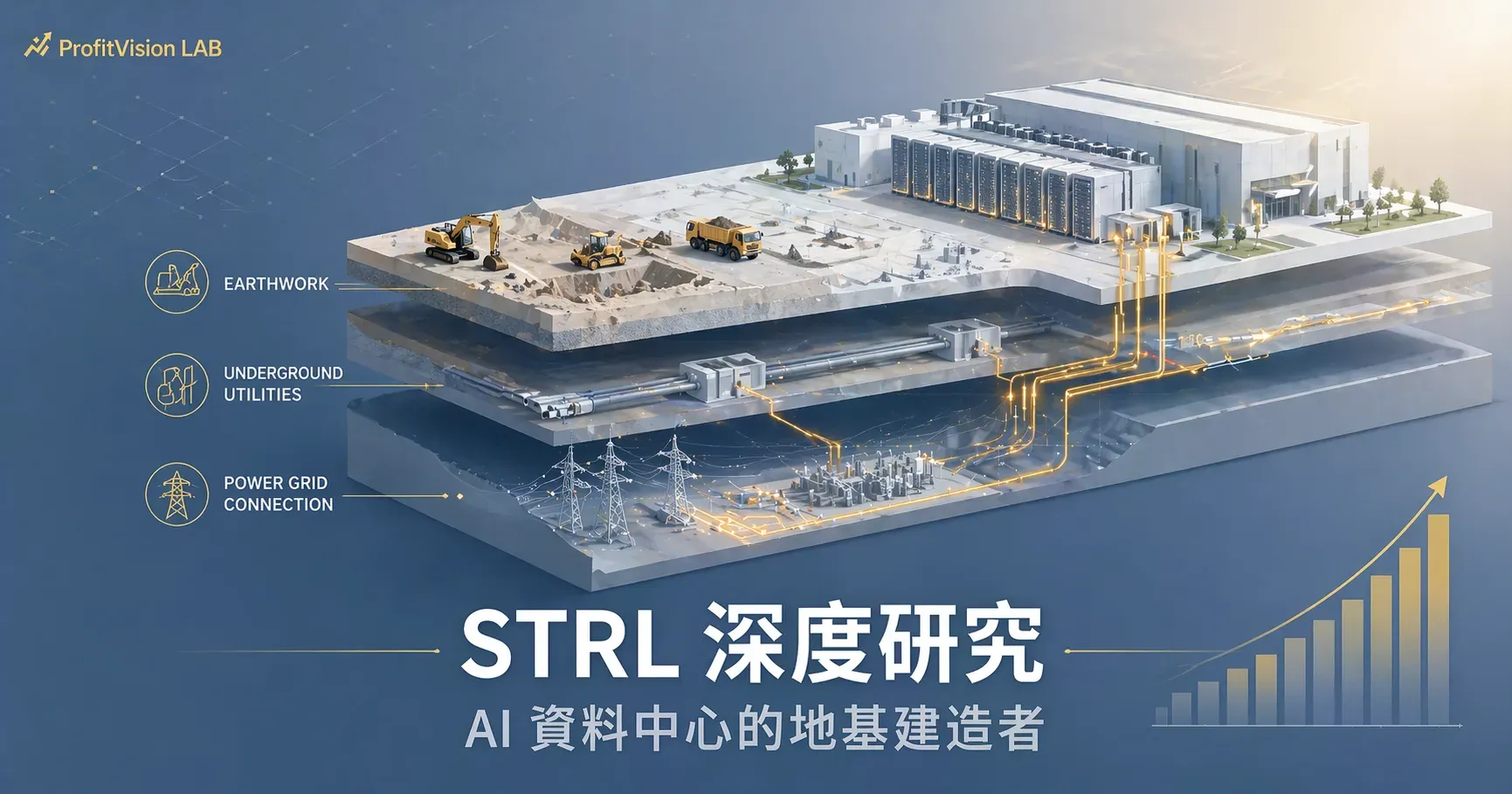
NYSE: STRL E-Infrastructure AI Capex Beneficiary Infrastructure Growth Stock
Four-Filter Quick Reference
| Filter | Metric | Data | Result |
|---|---|---|---|
| Filter 1: Ownership/Flow | Institutional Holdings / Relative Strength | Sustained institutional buying, estimated RS 90+ | ✅ Pass |
| Filter 2: Moat | ROE / EPS Growth | ROE 34.26%, EPS YoY +53% | ✅ Pass |
| Filter 3: Volatility | IV / Earnings Timing | Next earnings 2026/05/04, avoid new positions ahead of the print | ⏸️ Watch |
| Filter 4: Technicals | Price vs 50MA | $467 > 50MA $363, moving averages in bullish alignment, Minervini 8/8 | ✅ Pass |
Industry Map: The Full Landscape of AI Data Center Infrastructure
The bedrock of the AI revolution isn't the chip — it's the ground beneath it. Before the first server rack is installed, every AI data center must first complete hundreds of millions of dollars of site work and electrical infrastructure. Sterling Infrastructure (STRL) is the market leader in this critical but rarely-covered link in the chain.
Upstream-to-Downstream Industry Relationships
AI Data Center Infrastructure Value Chain (Upstream → Downstream)
① Land acquisition / site selection planning
② ⭐ E-Infrastructure (STRL): site grading, underground utilities, roads, parking, high-voltage electrical integration
③ General building contracting (structural construction)
④ MEP equipment installation (cooling, UPS, power distribution)
⑤ IT equipment installation (servers, networking, GPU clusters)
STRL's E-Infrastructure segment focuses on the earliest link, ②—the work that turns raw land into a buildable data center site. This link has one crucial characteristic: it must be completed before any other step can begin, and once a contractor is chosen, switching mid-project is extremely costly. This gives STRL a natural first-mover advantage within the order cycle.
Market Size: Hyperscaler 2026 Data Center Capex Totals Over $300 Billion
| Tech Company | 2026 Data Center Capex Guidance | YoY Growth | Implication for STRL |
|---|---|---|---|
| Microsoft | ~$80B | +40%+ | Azure AI capacity expansion, heavy site-work demand |
| Meta | $60–65B | +50%+ | More new campus sites, E-Infra prioritized |
| Alphabet (Google) | ~$75B | +40% | TPU training cluster expansion |
| Amazon (AWS) | ~$105B | +30% | Largest single potential customer |
Combined 2026 capex across the four hyperscalers exceeds $300 billion, with a substantial share flowing into data center site work and electrical infrastructure. Even if STRL captures only a small fraction of that pool, the addressable market represents a multiple-fold growth opportunity relative to the company's current size.
Three Growth Drivers
- Accelerating AI compute demand:Models like GPT-5, Gemini Ultra, and the Llama series are driving exponential compute demand, and training clusters require entirely new hyperscale campuses with 18–36 month build cycles. New orders continue to pour in.
- Power infrastructure bottleneck:The aging U.S. power grid means large-scale data centers (50–100 MW+) require custom high-voltage electrical integration — the scarcest construction capability in the market. STRL formally acquired this capability through its 2025 acquisition of CEC Facilities Group.
- Semiconductor manufacturing reshoring:The CHIPS Act is driving new semiconductor fab construction on U.S. soil, and STRL's E-Infrastructure segment also handles site-preparation work for fabs — adding a new engine of diversified growth.
Business Model and Moat
Revenue Mix Across Three Segments (FY2025)
| Segment | FY2025 Revenue Share | Core Business | Characteristics and Outlook |
|---|---|---|---|
| E-Infrastructure | ~70% | AI data centers, semiconductor fab site prep, underground utilities, high-voltage electrical | Backlog +79% YoY; 84% mission-critical; CEC integration upgrades electrical capability |
| Transportation | ~22% | Highways and bridges, aviation facilities, municipal infrastructure | Beneficiary of federal infrastructure legislation; stable cash-flow source; backlog at record high |
| Building Solutions | ~8% | Residential and light-industrial concrete flatwork, site preparation | Benefiting from residential construction recovery; improving margins |
The CEC Facilities Group Acquisition: The Final Piece of Full-Stack Integration
In September 2025, STRL completed its acquisition of CEC Facilities Group for $562 million. This was not a routine scale acquisition — it filled the most critical gap remaining in STRL's business map: high-voltage electrical integration capability.
What Did CEC Bring?
- High-voltage power distribution system design and installation capability (138kV+ transmission class)
- End-to-end contracting qualification for data center power infrastructure
- Vertical integration: site work (existing) + high-voltage electrical (new) = a complete turnkey service
- From the customer's perspective: a single-point contract, reduced coordination risk, shorter build timelines
Before 2025, what STRL delivered was "the site." After adding CEC, STRL can deliver "the powered site." For hyperscalers, this means the entire pre-construction infrastructure phase can be completed through fewer contractor interfaces — a highly differentiated value proposition.
Moat Type Analysis
Potential Weaknesses in the Moat (a Necessary Negative Assessment)
Scenarios Where the Moat Could Be Breached:
- Quanta Services (PWR) going all-in:PWR already has power-contracting scale, and if it pushes aggressively into data center site work, it could win business on the strength of its scale advantage.
- Labor bottleneck:High-voltage electrical technicians are in severe shortage, and STRL faces recruitment and retention pressure during its rapid growth phase, which could affect delivery quality on schedule.
- Customer concentration risk:A small number of hyperscalers make up the bulk of revenue — an impact from any single customer cutting capex would hit STRL harder than a more diversified contractor.
Competitive Landscape: Who Is the Real Threat?
STRL's competitive position needs to be understood along two dimensions: "companies that do similar site work" and "companies capable of doing E-Infrastructure." The intersection of these two dimensions is where the real competitors sit.
Key Competitor Comparison Matrix
| Company | Ticker | TTM Revenue | Gross Margin | EBITDA Margin | Core Business | E-Infra Exposure |
|---|---|---|---|---|---|---|
| Sterling Infrastructure | STRL | $2.49B | 23.0% | 20.2% | E-Infra + Transportation | ⭐⭐⭐⭐⭐ Highest |
| Quanta Services | PWR | $28.5B | ~14% | ~9–10% | Power / telecom infrastructure | ⭐⭐⭐ Partial overlap |
| Granite Construction | GVA | $4.4B | ~16% | ~12% | Highways / civil works | ⭐ Almost none |
| Primoris Services | PRIM | ~$6.0B | ~10% | ~7% | Utilities / pipelines | ⭐⭐ Partial |
| MYR Group | MYRG | ~$4.0B | ~5% | ~4% | Electrical contracting | ⭐⭐ Partial |
Data sources: company filings, SEC filings, public data (as of 2026/04)
Competitor-by-Competitor Analysis
STRL vs Quanta Services (PWR): The Competitive Risk Most Worth Watching
PWR is an engineering-contracting giant with a market cap over $100 billion and deep technical expertise in power transmission and distribution, and it has publicly signaled intent to push further into the data center electrical market. STRL's gross margin (23%) is far higher than PWR's (~14%), showing STRL has stronger pricing power in the niche of data center site development. However, PWR's scale advantage allows it to take on larger projects and bid at a lower marginal cost of capital. PWR is the competitive threat to STRL most worth watching over the medium-to-long term.
STRL vs Granite Construction (GVA): Almost No Overlap
GVA's business is centered on traditional highways, bridges, tunnels, and other public works, with very limited transition toward E-Infrastructure. In data-center-related business, competition between the two is essentially nonexistent. GVA is better viewed as an indirect competitor to STRL's Transportation segment rather than a threat to its core business.
STRL vs Primoris (PRIM): Differentiated Positioning
PRIM primarily serves utility pipelines and natural gas infrastructure. While there is some overlap with STRL's CEC business in certain power transmission and distribution areas, the end customers and construction types differ significantly, so this is not direct competition.
STRL vs MYR Group (MYRG): A Wide Scale Gap
MYRG is an electrical contractor with a gross margin of only around 5%, reflecting a highly commoditized business with intense price competition. STRL's vertically integrated site work plus electrical offering is differentiated and not a pure electrical-contracting play, so the two do not sit on the same competitive plane.
Conclusion: STRL currently holds a hard-to-replicate vertical integration advantage in the AI data center site development niche. The one competitive threat worth continuous monitoring is Quanta Services (PWR).
Geopolitics and Internationalization: Where the Opportunity Is, and Where the Limits Are
A question that comes up often: could STRL expand internationally to capture a share of sovereign AI buildouts in Saudi Arabia, the UAE, Japan, India, and elsewhere? The answer is: STRL doesn't need to go abroad — sovereign AI money will flow back to the U.S. on its own.
Nearly every national sovereign AI initiative (Saudi Arabia's NEOM AI city, UAE's G42, Japan's Digital Agency, India's IndiaAI) has, in its technical architecture, overwhelmingly chosen Microsoft, AWS, and Google as platform providers. This means a substantial share of "sovereign AI" actually materializes as expanded compute infrastructure on U.S. soil (or at U.S. companies' overseas data centers) — rather than each country building its own independent compute center. As the preferred E-Infrastructure supplier within the United States, STRL is an indirect beneficiary of this capital chain without needing to expand abroad itself.
The internationalization opportunity that actually matters runs in the opposite direction — "foreign manufacturers building plants in the U.S." TSMC's Phoenix Fab 21, Samsung's Texas fab, Intel's Ohio fab — every semiconductor fab requires a complete site-development scope before groundbreaking: land preparation, underground utilities, high-voltage power hookup, cooling water systems — all of which fall within STRL's E-Infrastructure core service scope. TSMC brings its Taiwanese equipment and materials suppliers to the U.S. when it builds a fab, but it will never bring Taiwanese civil contractors along — U.S. construction permitting, occupational safety regulation, and federal engineering codes mean foreign contractors essentially cannot qualify in the short term. Flip that logic around and: the CHIPS Act-driven reshoring of semiconductor manufacturing is STRL's most certain second growth engine for E-Infrastructure after AI data centers.
| Geopolitical Theme | Direction of Impact on STRL | Certainty |
|---|---|---|
| Sovereign AI buildouts globally | ✅ Indirect positive (capital flows to U.S. hyperscaler capex) | Medium-high |
| TSMC / Samsung / other fabs built in the U.S. | ✅ Direct positive (semiconductor fab site development) | High (CHIPS Act funding already appropriated) |
| Manufacturing reshoring (EV plants, battery plants) | ✅ Direct positive (plant site development) | Medium (driven by IRA EV subsidies) |
| Foreign contractors entering the U.S. market | ⚠️ Low-level threat (high licensing and customer-relationship barriers) | Low (nearly impossible in the near term) |
| U.S. hyperscalers building overseas facilities | ❌ Not a beneficiary (STRL has no overseas operations) | — (outside STRL's service scope) |
In other words, STRL's best strategy is to keep deepening its focus on the domestic U.S. market — because the U.S. is becoming the central node of global AI compute and semiconductor manufacturing, and at that node, nearly all construction demand must pass through domestic specialty contractors like STRL to actually get built.
Financial Resilience: Three-Year P&L Trend and Balance Sheet Health
Three-Year P&L Trend
| Financial Metric | FY2023 | FY2024 | FY2025 | YoY Growth (2025) |
|---|---|---|---|---|
| Revenue | $1.58B | $1.89B | $2.49B | +32% |
| Gross Margin | ~17% | ~20% | 23.0% | +300 bps |
| EBITDA Margin | ~13% | ~16% | 20.2% | Broke above 20% for the first time |
| Adjusted EPS | ~$4.80 | ~$7.10 | $10.88 | +53% |
| Free Cash Flow (FCF) | ~$150M | ~$230M | $363M | +58% |
| FCF Margin | ~9.5% | ~12% | 14.6% | Continuing to improve |
Over three years, STRL's financial structure has fundamentally transformed — from a traditional, low-margin infrastructure contractor into a high-margin growth company centered on AI data centers. EBITDA margin has jumped from 13% to 20.2%, and this is not the product of one-time cost cuts, but a structural margin improvement driven by a shift in the business mix.
Balance Sheet Health Metrics
A D/E of 0.26 is extremely conservative leverage for the infrastructure industry, and even after completing the $562 million CEC acquisition, the balance sheet remains healthy. The Altman Z-Score of 7.58 is well above the safety threshold (>3), indicating essentially no risk of financial distress over the next two years.
Backlog Visibility
| Backlog Type | Amount | Description |
|---|---|---|
| Contracted backlog | $3.01B | Work under signed, confirmed contracts |
| Combined backlog (including framework agreements) | $3.31B | Includes estimated work volume under long-term framework agreements |
| Mission-critical share of E-Infra backlog | 84% | Locked-in orders that are difficult to cancel and carry high switching costs |
| Backlog YoY growth (E-Infra) | +79% | Shows front-end AI capex is still ramping rapidly |
The $3.31 billion combined backlog is equivalent to roughly 1.3 times FY2025 full-year revenue, providing strong visibility into 2026–2027 results. More importantly, the fact that 84% of the backlog is mission-critical means that even if the broader capex environment turns volatile, the risk of already-locked-in orders being cancelled is relatively limited.
2026 Financial Guidance
FY2026 Management Guidance (Latest)
- Revenue: $3.10–$3.20B (midpoint $3.15B, YoY +26%)
- Adjusted EPS: $13.45–$14.05 (midpoint $13.75, YoY +26%)
- Capex: $100–110M
- Consensus Q1 2026 EPS: $2.18, revenue $606M
Valuation and Scenario Analysis: Is $467 Reasonable?
We do not set a fixed price target. Instead, we use a three-scenario framework so investors can assess the risk/reward for themselves.
Three-Scenario Valuation Framework
| Scenario | Core Assumption | 2026E EPS | Forward P/E | Implied Valuation Range | vs Current Price $467 |
|---|---|---|---|---|---|
| 🐂 Bull | Guidance broadly beaten; E-Infra organic growth 25%+; CEC integration synergies exceed expectations | $14.50 | 40x | ~$580 | +24% |
| ⚖️ Base | Guidance midpoint delivered; E-Infra grows steadily; CEC integration proceeds on schedule | $13.75 | 34x | ~$467 | In line with current price |
| 🐻 Bear | Hyperscalers cut capex; customers cancel or delay orders; backlog growth decelerates | $12.50 | 26x | ~$325 | -30% |
Reading the Market's Pricing
The current price of $467 corresponds to the base-case valuation ($467), meaning the market has already fully priced in the midpoint of guidance. This implies:
- Upside requires an above-expectations catalyst:Only if Q1 2026 earnings (5/4) meaningfully beat the $2.18 EPS estimate and full-year guidance is raised would there be a realistic chance of re-rating toward the bull scenario.
- Downside risk is asymmetric:The -30% downside in the bear scenario suggests the current price offers no margin of safety, and it makes sense to wait for earnings confirmation before initiating a position.
- TTM P/E of 50.44x looks expensive, but Forward P/E of ~34x is more meaningful:Given a three-year EPS CAGR of 44%, a PEG-ratio analysis puts the forward PEG at roughly 0.8x — not an excessive valuation.
Valuation Benchmark: Why Use a 34x Forward P/E?
Infrastructure contractors have historically traded at 15–25x P/E. STRL's premium comes from: (1) a structural business transformation into high-growth tech infrastructure; (2) a 23% gross margin far above traditional contractors; and (3) the earnings visibility provided by its backlog. The 34x multiple reflects the market pricing in these three premium factors, and it is not a significant bubble.
Options Strategy: Bull Put Spread Logic
Wait for a VCP (Volatility Contraction Pattern) After Earnings
- Trigger conditions:After the 2026/05/04 earnings report, confirm E-Infra backlog continues to grow 50%+ YoY and full-year guidance is maintained or raised
- Strategy:Bull Put Spread — short put roughly 10% below the 50MA (~$330), long put at $310 for downside protection
- Logic:With bullish technical alignment and healthy fundamental backlog, the area near the 50MA is a strong support zone, offering a favorable risk/reward for collecting time-value premium by selling puts
- Current recommendation:IV is elevated ahead of earnings — stay on the sidelines for now and reassess the pattern after the print
Conclusion and Tactical Recommendations
Core Thesis (in one sentence):If you believe in the AI data center buildout, buy the ground first — STRL is the most front-end, most certain beneficiary of the AI capex cycle.
Bull Case (Three Reasons for Upside)
- E-Infrastructure organic growth exceeding expectations:Combined 2026 hyperscaler data center capex exceeds $300 billion, STRL's backlog is already up 79% YoY, and the trend is still accelerating — the company doesn't need new customers to sustain strong growth.
- Accelerating CEC integration:High-voltage electrical integration capability lets STRL bid on larger, turnkey contracts, raising the average contract size per project. A large, integrated contract win in Q2–Q3 2026 could trigger a valuation re-rating.
- Transportation backlog at a record high:Continued federal infrastructure funding flowing to state budgets keeps the Transportation segment as STRL's cash-flow stabilizer. Continued outperformance here would help reduce the concentration-risk discount tied to E-Infra.
Bear Case (Three Downside Risks)
-
The lag effect of an AI capex slowdown: this is the risk most easily misunderstood.
Many people treat STRL as an "AI concept stock" and assume it would crash immediately if AI capex cools — that view is wrong on the timing, though right on the eventual direction. The actual transmission path is: if hyperscalers cut capex, the first thing affected is the pace of new order intake, not current-period results. STRL's current $3.01 billion contracted backlog is roughly 1.2x annualized revenue, meaning even if new order intake stopped completely today, FY2026 results are already nearly locked in. The real earnings pressure would show up in the second half of 2027 through 2028 — but the stock price typically reflects that expectation 6–12 months in advance. In other words, investors should monitor not "when will results deteriorate" but "when will the market start to worry about order visibility." Trigger point: any single hyperscaler announcing a 2027 capex plan cut of more than 15% versus original estimates. -
Nonlinear risk from customer concentration:
The E-Infrastructure segment's main customers are highly concentrated in Amazon and Meta. This concentration acts as a "moat" during growth periods (deep integration, multi-year framework agreements), but becomes a "catalyst" during contraction — if one of these key customers delays its 2026–2027 expansion plans, the hit to STRL's backlog conversion rate would be disproportionate. This risk cannot easily be offset by the Transportation or Building segments, since combined they account for only about 30% of the total. -
Valuation compression from a 34x forward P/E amid earnings uncertainty:
The current price of $467 almost exactly prices in management's FY2026 base-case guidance (EPS $13.75 × 34x ≈ $468). That leaves the market no room for a "surprise" — if Q1 2026 (earnings on 5/4) EPS comes in below the $2.18 estimate, or full-year guidance isn't raised, the valuation multiple itself would come under pressure. Historically, high-P/E growth stocks often face a 20–30% compressive correction in the first quarter that growth decelerates — this nonlinear downside risk is precisely why options traders should manage this name with spread structures rather than naked puts.
Important reminder: STRL's E-Infrastructure demand doesn't come from AI data centers alone. Semiconductor fab reshoring (CHIPS Act), manufacturing reshoring (IRA), and traditional Transportation government contracts together make up roughly 45–50% of total business. Even if AI capex sees a meaningful pullback in 2027–2028, these demand sources provide a degree of buffer — this is the fundamental structural difference that makes STRL more resilient to an AI cooldown than a "pure AI concept stock."
Trigger Conditions: Upgrade vs Downgrade
| Direction | Trigger Condition | Recommended Action |
|---|---|---|
| ⬆️ Upgrade | E-Infra backlog continues to grow 50%+ YoY; Q1 EPS beats $2.18; full-year guidance raised | Confirm VCP pattern after earnings, consider initiating a Bull Put Spread |
| ⬇️ Downgrade | A hyperscaler announces a capex cut of more than 15%; backlog YoY growth falls below 30% | Exit all positions, reassess valuation |
Tactical Summary
Current Recommendation: Actively wait and watch (no new positions ahead of earnings)
- The current price of $467 already fully reflects the base case, with no margin of safety
- IV is elevated ahead of the 2026/05/04 Q1 earnings report, unfavorable for options time value
- If backlog remains healthy and guidance is maintained after earnings, wait for a VCP contraction pattern before establishing a Bull Put Spread
- Over the long term, STRL's business transformation thesis remains intact and it is well suited as a core holding within an AI infrastructure theme
Long-term thesis:The AI data center buildout cycle isn't a one-year story — it's a 5–10 year structural trend. STRL's vertical integration capability, backlog visibility, and execution track record make it one of the most reliable beneficiaries of this trend.
Tracking Record
| Date | Event | Call | Outcome |
|---|---|---|---|
| 2026/04/22 | Initial publication (Deep Dive v2) | ⏸️ Actively watching (ahead of earnings) | — |
Next update:After Q1 2026 earnings (2026/05/04)
Early-update trigger:A hyperscaler announces a capex cut of 15%+
⚠️ Disclaimer
This article is for research reference only and does not constitute investment advice. Investing involves risk; please evaluate carefully based on your own financial situation. Data sources: SEC filings, company financial reports, StockAnalysis, and other public data. All figures are as publicly disclosed, and the views expressed are the author's own.