NVIDIA 2026Q4 Earnings Analysis: The Power Shift Behind "Traffic Diversification" and "System Output"
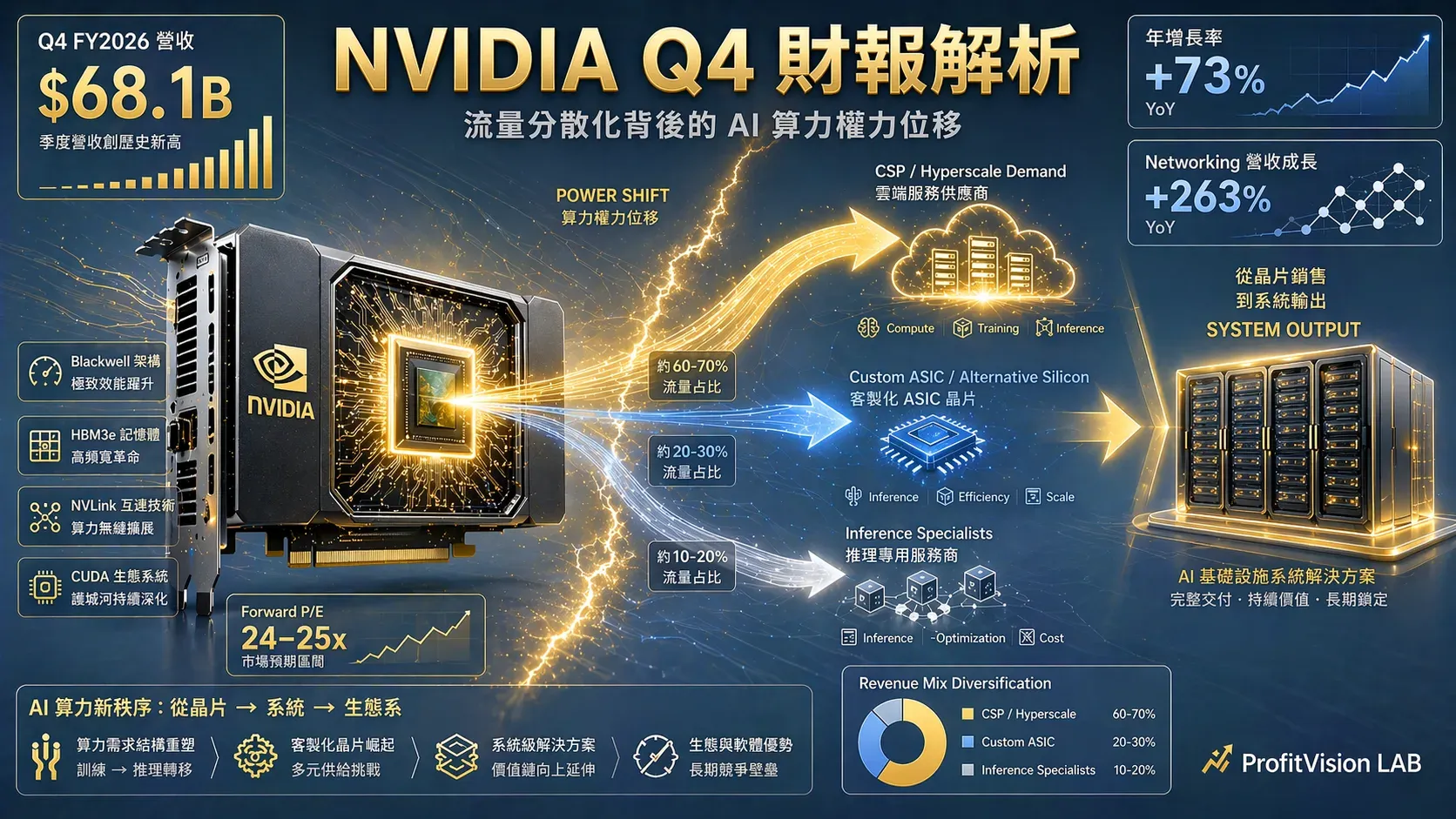
NVIDIA posted $68.1B in quarterly revenue, up 73% YoY — but what really matters isn't the number. It's three forces — the rise of Groq/inference, hyperscalers' in-house accelerators, and the Direct-to-CSP model — that are reshaping how AI compute gets allocated.
Introduction: Only Those Who Understand "Traffic" Can See the Profit
Investors who have spent twenty years in the U.S. markets know that sentiment fluctuates and valuations reset, but one truth never changes: where the traffic is, the profit is.
On February 25, 2026, NVIDIA (NVDA) reported its fiscal 2026 fourth-quarter results. This wasn't just a "beat expectations" scorecard — it's a strategic white paper on how the "AI compute network" is shifting from concentrated hyperscalers to distributed real-world industries.
While the public is still debating when capital expenditure (CapEx) will peak, the data and strategic positioning revealed on the earnings call already send a clear signal: NVIDIA is using its lead in "System Output" to evolve from "a chip vendor" into "the toll-collector that defines the AI industrial standard."
I. Cutting Through the Data: Finding the "Second-Order Signal" Within Explosive Growth
Before unpacking the deeper logic, let's first look clearly at how this "cash-flow machine" actually performed in F4Q26:
Non-GAAP EPS growth (94%) far exceeded revenue growth (73.2%), showing that operating leverage is still in an explosive phase. Networking's +263% YoY growth further validates Jensen Huang's remark: "The center of gravity in AI competition has shifted from single-point compute to networked scale."
| Financial Metric | F4Q26 Figure | YoY Growth | Investment Implication |
|---|---|---|---|
| Quarterly revenue | $68.13B | +73.2% | A cash-flow machine that keeps beating expectations |
| Non-GAAP EPS | $1.62 | +94% | Operating leverage exploding, profit growth far outpacing revenue |
| Networking revenue (in-datacenter) | $11B | +263% (3.6x) | Networked scale becoming the core competitive axis |
| Quarterly free cash flow | $35B | —— | Firepower to defend the stock, backing the bulls |
| Full-year free cash flow | $97B | —— | The annual cash-flow machine running at full speed |
| Remaining buyback authorization | $58.5B | —— | Any pullback has official support behind it |
II. The Last Piece of the Inference-King Puzzle: The Groq Integration and "Agentic AI"
There was once a bearish script: general-purpose GPUs are only suited for training, and inference will be taken over by specialized chips (ASICs). On the earnings call, NVIDIA formally confirmed its licensing agreement and team integration with Groq, thoroughly shattering that fantasy.
The New Economics of "Compute Equals Revenue"
Jensen Huang put forward a strikingly incisive concept on the call: Compute equals revenues. In the age of Agentic AI, inference is no longer a cost — it's a factory that produces "tokens," and tokens are revenue.
The Accelerating Effect of Groq's Technology
By integrating Groq's low-latency inference technology with the new InferenceX software stack, the Blackwell system has cut the "cost per token of inference" by 35x compared to Hopper. When NVIDIA can offer an inference solution that's both faster and cheaper than a self-developed ASIC, it effectively monopolizes the traffic gateway to "AI agents."
III. The Pinnacle of White-Label Strategy: "System Output" via GPU + LPU + NVLink
The most forward-looking observation in this earnings report: NVIDIA is transforming from "a component vendor" into "a system architecture licensor." NVIDIA announced that it is enabling AWS to integrate its own custom silicon using NVLink — and the second-order thinking behind this is:
- The "in-house vs. outsourced" dynamic: Hyperscalers develop their own chips for "in-house use," to reduce their own CapEx pressure. But even these giants must adopt NVIDIA's NVLink interconnect architecture to achieve large-scale clustering.
- The GPU + LPU + NVLink turnkey solution: What NVIDIA exports is no longer a single piece of IP — it's "System Output," a bundle combining GPU (compute), LPU (low-latency inference), and NVLink (the data bloodstream).
- The driving force behind the white-labeling of Taiwan's ecosystem: By licensing its IP to MediaTek for SoC development, and enabling design work through Alchip, Marvell, and Astera Labs, NVIDIA has successfully turned NVLink into an "industrial standard." This mirrors the old MediaTek "reference-design phone" playbook — letting companies worldwide (telecoms, manufacturers) quickly gain access to a standardized answer, while NVIDIA sits comfortably at the center, collecting extremely high-margin IP royalties.
IV. Structural Transformation: From "Cloud Concentration" to "Edge Diversification"
The bears' fear of a "2027 CapEx cliff" is based on the old cloud-buildout logic. But on the earnings call, the CFO noted that AI demand is undergoing a qualitative shift from "concentrated" to "distributed": the top five cloud customers account for roughly 50%, but "other" customers are growing extremely fast.
| Emerging Customer Segment | Representative Use Case | Scale and Growth |
|---|---|---|
| Sovereign AI | National-level AI infrastructure | Already surpassing $30B, up 3x |
| Enterprise data centers | Private AI deployments | The CUDA ecosystem present across every enterprise |
| AI model developers | New AI-native companies | Blackwell systems in short supply |
| Telecom and edge nodes | Low-latency AI inference | GPU+LPU+NVLink entering telecom facilities |
| Physical AI | Manufacturing, robotics, autonomous driving | Already contributing over $6B in FY26 |
NVIDIA's advantage lies in this: CUDA is already present across every cloud, every enterprise, every edge device. This "platform ubiquity" turns diversification into an accelerant rather than a headwind:
- Telecom IDC deployment: telecom operators have the edge nodes closest to end users. As the "GPU + LPU + NVLink" system enters telecom facilities, once-clunky telecom infrastructure will upgrade into low-latency AI nodes.
- Physical AI and Sovereign AI: NVIDIA disclosed that "Physical AI" contributed over $6B in revenue in fiscal 2026; Sovereign AI grew threefold to surpass $30B.
- The diversification dividend: as AI lands in AI PCs, autonomous driving (the DRIVE platform), Industry 4.0, and countless end devices, NVIDIA's customer base is no longer confined to five tech giants.
V. Second-Order Thinking: Valuation Logic and Mispricing
The bull case: the appeal of a PEG below 0.5. When earnings growth is running as high as 70–90%, yet the P/E sits at just 24x, it signals a serious market misperception of the long-term toll-collecting power that the "System Output" model confers. This is typically the "sweet spot" where professional investors position themselves.
VI. Conclusion: Three Coordinates to Watch Going Forward
Jensen Huang used a phrase: AI factories — this isn't a figure of speech, it's the language of an industrial revolution.
Looking ahead:
- Every enterprise becomes a token producer
- Every data center becomes a production unit
- Every AI system becomes a revenue machine
From Agentic AI to Physical AI (manufacturing, robotics, autonomous driving), compute is moving into the physical world. For professional investors deeply engaged with this market, the following three strategic metrics are worth tracking going forward:
| Strategic Metric | What to Track |
|---|---|
| ① System Output integration progress (InferenceX + NVLink Fusion) | Watch partners (MediaTek, Alchip, ALAB) for actual progress in lowering "cost per token of inference" |
| ② Telecom edge-node and distributed-IDC revenue | Watch whether the share of "non-cloud-provider" revenue within telecom data-center segments continues to climb |
| ③ The Blackwell-to-Rubin transition | Rubin samples have already shipped, confirming mass production entering in the second half; the relentless one-year cadence is the key to maintaining the technology lead |
Where the traffic is, the profit is.
Right now, global AI traffic is flowing through the standardized "GPU + LPU + NVLink" system, toward the invisible dominance NVIDIA is building.
Investing involves risk; please evaluate carefully according to your own financial circumstances.
Data sources: SEC filings, company earnings reports, public information