Power Isn't a Cost — It's the Seat of Control in the AI Era
AI's power demand isn't a short-term phenomenon — it's the Jevons Paradox taken to its extreme. The more chips advance, the more use cases emerge, and the more power gets consumed. Capital is rotating from chasing chips to chasing power — whoever has power gets to use the GPUs.
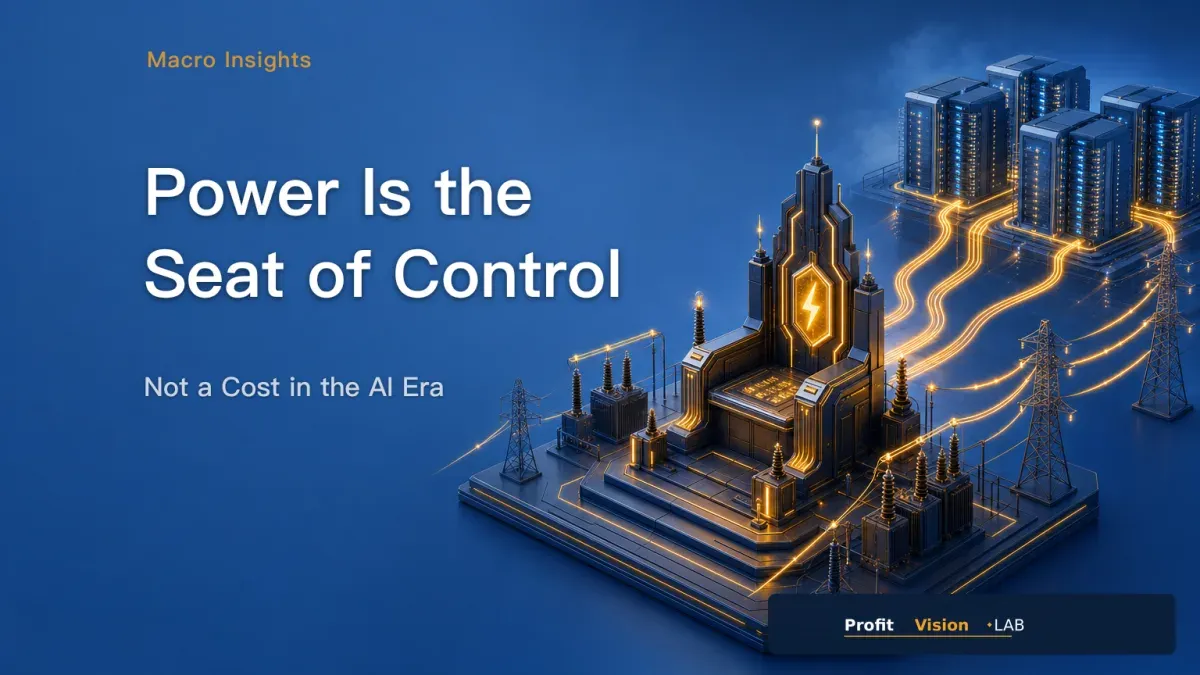
- AI's power demand is structural, not cyclical — the Jevons Paradox guarantees that efficiency gains lead to more electricity consumption, not less
- Power availability has replaced land and network connectivity as the number-one constraint on data-center siting
- Capital is rotating from Phase One (chasing chips) to Phase Two (chasing the energy and grid infrastructure that keeps the chips running)
- Volatility in power-related names stems from market sentiment, not fundamental deterioration, which naturally satisfies all three entry conditions of an options-selling strategy
- This thesis has clear failure conditions — overvaluation, a breakthrough in model efficiency, or a downturn that cuts capex — recognizing these boundaries is what lets you use the framework correctly
The Market's Most Dangerous Misjudgment
Chip process technology keeps advancing, and power consumption falls with every generation. Intuitively, many people arrive at the following conclusion:
This misjudgment held true in the industrial era. But the AI era has one fundamental difference: it isn't using fewer resources to do the same thing — it's continuously opening up new use cases.
The Jevons Paradox: Why Does Greater Efficiency Actually Consume More Power?
In 1865, the British economist William Stanley Jevons, studying the steam engine, discovered that when the steam engine's efficiency improved dramatically, coal consumption rose rather than fell. The reason was that greater efficiency lowered the cost of use, which stimulated far broader adoption and increased total consumption.
This phenomenon is playing out again in the AI era — at a far larger scale.
- NVIDIA's H100 is roughly 3x more energy-efficient than the prior-generation A100, yet total power consumption across global GPU clusters keeps accelerating
- Training GPT-3 consumed about 1,287 MWh; training GPT-4 is estimated to have exceeded 50,000 MWh — a more than 38x increase
- A single ChatGPT query consumes roughly 10x the power of a Google search; global daily ChatGPT queries have already surpassed 100 million
- The IEA forecasts that global data-center electricity consumption will reach 1,000 TWh by 2026 — equivalent to Japan's entire national electricity consumption
The more chips advance, the larger the models get, the more use cases emerge, and the higher the query frequency climbs. The result isn't using less power to do the same amount of work — it's:
AI Isn't a Tech Product — It's a New Category of Infrastructure
If you're still evaluating AI as a "tech stock," you're using an outdated framework to assess what is actually an infrastructure problem.
AI is, in essence, compute infrastructure, and this infrastructure runs into a physical limit it cannot get around: electricity.
More critically, AI's power demand has a two-layer structure:
- Training — extremely energy-intensive; a single training run of a large model can consume the equivalent of a year's electricity for hundreds of households
- Inference — sustained, ongoing consumption; every query and every generation requires compute to back it
Training is the peak; inference is the base load. As AI penetrates every industry — financial risk control, medical diagnostics, manufacturing automation — the power demand from inference will become a permanent baseline load, not an intermittent spike.
- Microsoft, Google, Meta, and Amazon's combined 2024 capex exceeded $200 billion, with the majority flowing into data-center construction
- A single hyperscale data center consumes 100–500 MW of power — equivalent to 100,000–500,000 households
- Microsoft has signed a 20-year nuclear PPA with Constellation Energy, restarting the Three Mile Island nuclear plant to supply AI computing exclusively
- Google announced in 2024 that its total PPA capacity had surpassed 10 GW, making it the largest corporate renewable-energy buyer in the world
Why Has Power Become AI's Real Bottleneck?
While the market is still arguing about "who has the strongest GPU," the underlying logic of competition has already shifted:
This brings three concrete structural shifts:
1. The Top Criterion for Data-Center Siting Has Shifted From Networking to Power
Data-center siting used to be about land cost and network connectivity quality; now there's a new veto-level condition: power availability. Northern Virginia (the world's largest data-center cluster) has already seen new power-interconnection wait times exceed 5 years, directly constraining how fast new compute can be deployed.
2. Long-Term Power Purchase Agreements (PPAs) Have Gone From a Cost Tool to a Strategic Asset
The Power Purchase Agreement — a long-term contract locking in a 10–20 year power supply — is becoming a core strategic move for tech giants. This isn't about saving on electricity bills; it's about making sure compute expansion doesn't get blocked by power supply. For utilities, this means highly certain cash flow; for tech companies, it's the ticket to growing their compute footprint.
3. The Grid Itself Is the Last Bottleneck
More generation capacity doesn't mean more usable power. Transmission and distribution is the final chokepoint. The average age of equipment on the US grid exceeds 40 years, and the concentrated deployment of data centers in specific regions is causing localized grid overload. This is also why grid-upgrade-related names are being repriced.
Three Layers of Capital Flow
The market is currently in Phase One — chasing chips (NVIDIA, AMD). But Phase Two is already unfolding: chasing the infrastructure that supports the chips. Capital will flow in three directions:
Power Supply
Grid Upgrades
Energy Fuels
Why Is This Theme Naturally Suited to Selling Strategies?
Not every name you're bullish on is suitable for a direct buy. Power and grid stocks have three characteristics that make them a natural fit for options-selling strategies:
Under What Conditions Would This Thesis Fail?
An honest analysis has to be clear about where it might be wrong. The following two counterarguments have real historical grounding, and I take them seriously.
Applied to AI power: utility stocks have already risen 50–100% in 2023–2024. If AI adoption comes in slower than expected, or a technology breakthrough like DeepSeek R1 delivers a step-change in inference efficiency, the power-demand growth curve could slow, and current valuations would be hard to sustain.
But the valuation risk is real. This framework's precondition is deploying capital at reasonable valuations or on pullbacks, not chasing in after the story is already fully priced. This is exactly where the advantage of a selling strategy comes in — you don't need to call the top; you just wait for the market to correct on sentiment and IV to rise, then act.
Demand side: AI inference has already embedded itself deep in core enterprise workflows, and this power demand won't drop to zero just because the economy slows — much like cloud services kept growing through the 2020 pandemic shock. What's genuinely at risk is training-side capex (large model training), which can indeed be delayed during a downturn.
Stock-price side: utility stocks will fall during a downturn — that's a given. But that isn't the thesis failing — it's a buying opportunity appearing. The question isn't "will this trend happen," it's "at what valuation and timing do you get in." Using a selling strategy during a downturn, setting your strike below a reasonable support level, is precisely the most direct way to handle this risk.
The Explicit Conditions Under Which This Framework Fails
If any of the following occurs, the core thesis of this article needs to be reassessed:
Recognizing these boundaries isn't a rejection of this article's thesis — it's about knowing under what conditions this framework still holds, and under what conditions you need to pause or adjust your position. That is what genuine risk-management thinking looks like.
Final Conclusion: You're Asking the Wrong Question
The market's attention is focused on the wrong question:
"Will chips keep getting more power-efficient?"
The answer to that question is yes — but it's completely beside the point.
The real question is:
"Will AI cause humanity to consume more electricity?"
History has already answered this. After the steam engine got more efficient, Britain's coal consumption rose rather than fell. After car engines got more efficient, global oil consumption kept expanding. Every technological-efficiency revolution has, in the end, produced an explosive increase in total consumption — not conservation.
AI is the latest performance of this pattern — and it's bigger and faster than any before it.
Power isn't a short-term need — it's the underlying asset of the AI era.
Chips determine who runs fast, but power determines who even gets to play.
The next thing to get repriced isn't AI itself — it's the entire energy and grid system that keeps AI running.
The market's rotation from chasing chips to chasing power isn't a trend — it's a logical inevitability.
What you're seeing right now is only the starting point of that rotation.
Disclaimer: everything in this article is for research and educational reference only and does not constitute investment advice. Any stocks or ETFs mentioned are for illustrative purposes only and do not represent any recommendation to buy or sell. Investors should assess their own risk tolerance, financial situation, and investment objectives, and bear the corresponding risk.