Leverage Rent Collection: The Duet of Margin and the Covered Call
Combining margin-financed stock with a Covered Call turns leverage into a steady stream of premium cash flow. This article breaks down the risk structure, position management, margin rules, and when this approach is appropriate — and when it absolutely is not.
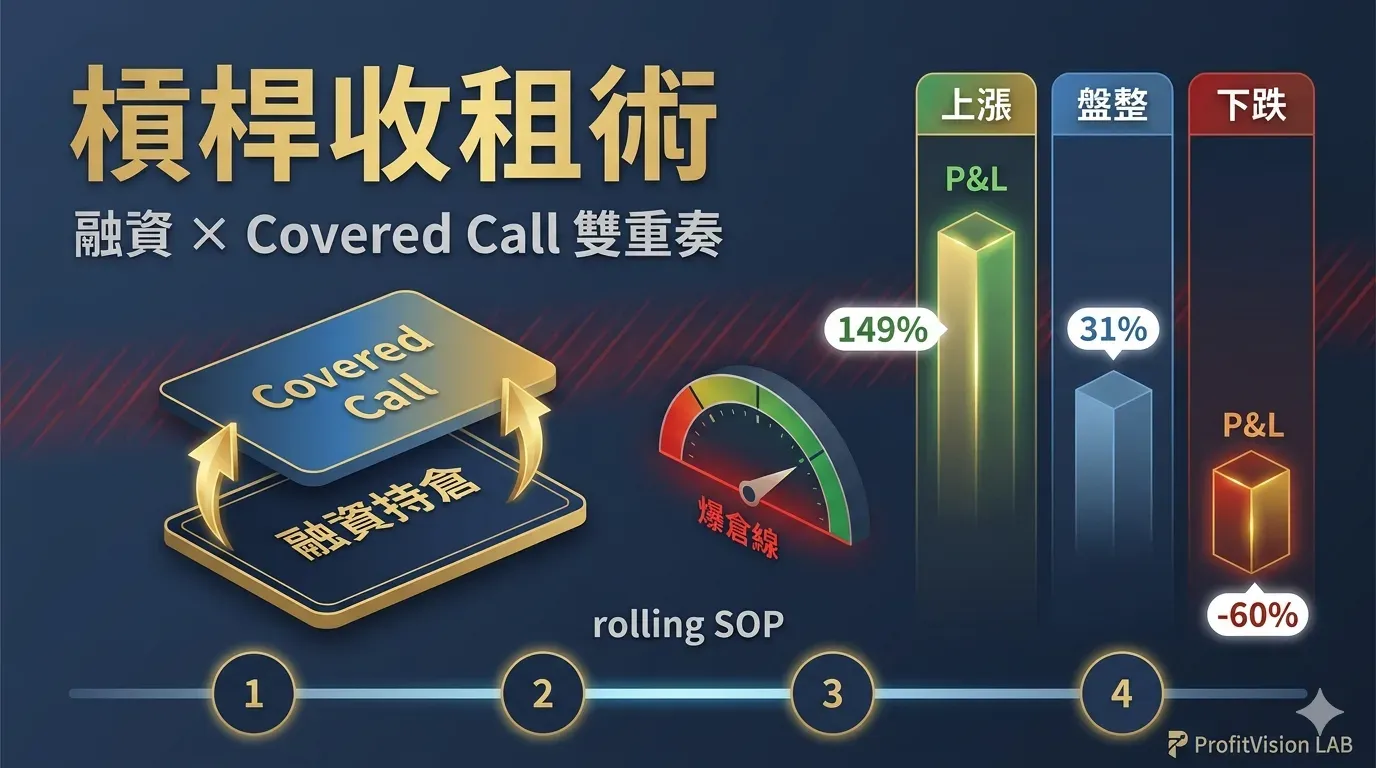
Leverage Rent Collection: The Duet of Margin and the Covered Call
The Core Setup: Capital Structure
Suppose we buy 100 shares at $20.67, for a total position of $2,067. Of that, $517 is our own capital and $1,550 is on margin (at a 4.5% annual rate). At the same time, we sell a Call expiring in six months with a $25 strike, collecting $150 in premium.
What you're actually putting at risk isn't $517 — it's 517 − 150 = $367 (net capital at risk)
You're controlling a $2,067 asset with $367. That's the appeal of leverage — and also the source of the risk.
Return Scenario Analysis
Including roughly $35 of margin interest over six months, here are the three scenarios:
(assigned)
The P&L Structure at a Glance
The Real Risk: Not Losing Money — Getting Knocked Out
Controlling $2,067 with $367 is roughly 5.6x leverage. As the price fluctuates, your maintenance margin compresses quickly. Brokers typically don't treat the option premium as a margin cushion, and once you breach the maintenance-margin threshold, you may trigger a margin call — or even a forced liquidation.
The question isn't whether you'll eventually profit — it's: can you survive long enough to get there?
The Condition for Survival: A Cash Buffer
This money isn't for adding to your position — it has exactly one purpose: getting you through normal volatility without being knocked out of the market.
As long as you stay in the game, time value has a chance to work in your favor.
Advanced Execution: Systematic Rent Collection
Closing the Strategy Loop
The core logic of this strategy is a continuous cycle:
Assigned → sell a put, wait for a pullback, and re-enter; not assigned → keep holding the stock and sell the next round of calls to keep collecting rent.
Stack the three disciplines of "closing early + rolling on a schedule + margin management," and the strategy upgrades from a one-off trade into a repeatable cash-flow system.
The essence of this strategy isn't chasing the highest possible return — it's building a structure that can survive market volatility.
A high return was never the hard part. Surviving the volatility is.