Debt-Financed Buybacks: Most People Are Asking the Wrong Question
Debt-financed share buybacks are the most common capital-allocation tool among mature U.S. companies, but most investors only see the surface-level "EPS boost" and miss the tax-shield logic, liquidity considerations, and CEO incentive structures behind it. The tool itself is neither good nor bad -- what matters is the skill of the user. Judging whether a company's buyback is an accelerator or a bomb only takes four questions. The framework is here; the answer is yours to find.
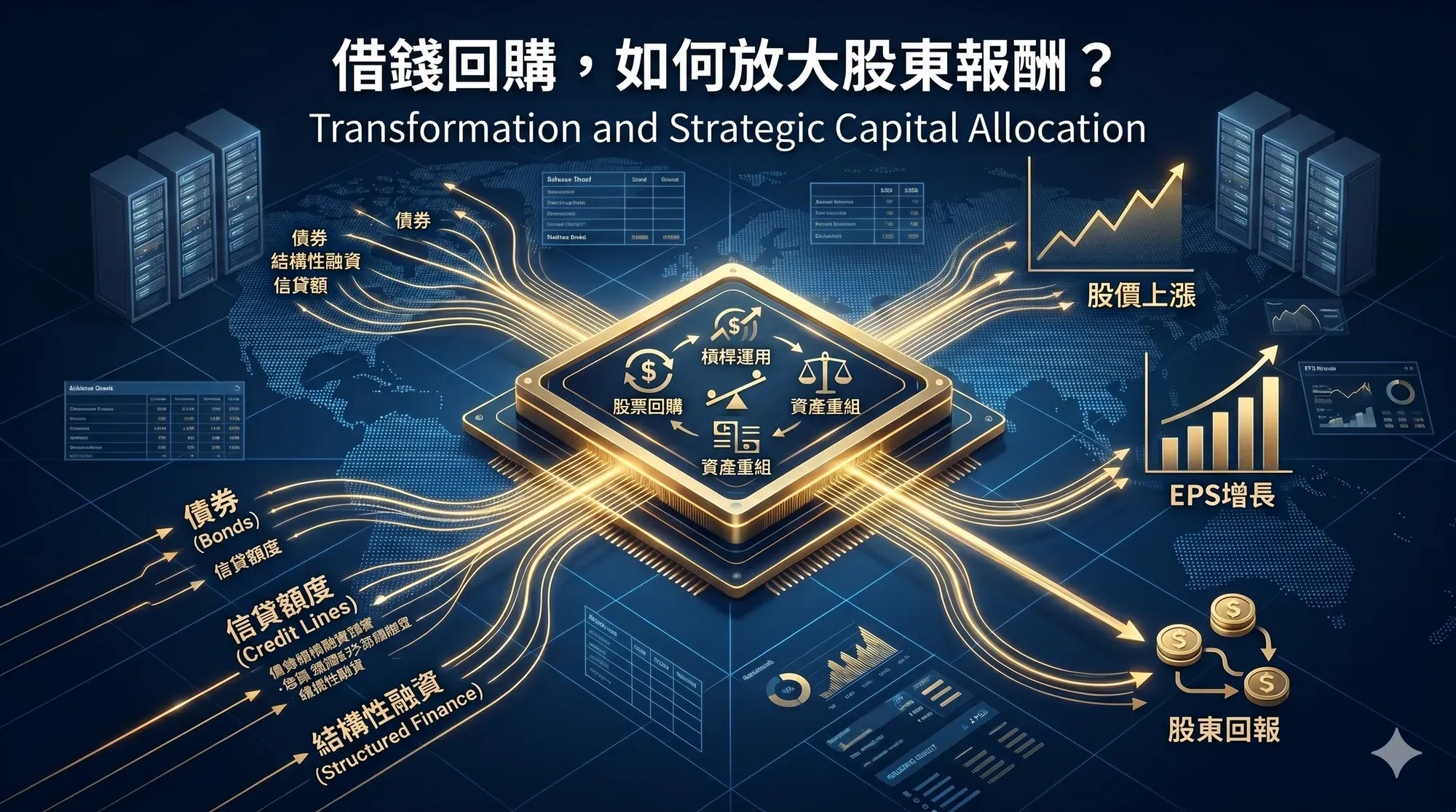
When you see a company loaded with debt on its balance sheet, what's your first reaction?
Most people would say: "Dangerous, stay away."
But in the capital markets, that instinct will make you miss some of the most profitable companies out there.
Debt-financed share buybacks are one of the most commonly used capital-allocation tools among mature U.S. companies. It's a neutral tool — the outcome depends entirely on the skill of the person using it.
This article's job is to help you build a framework for making that judgment.
I. What Is It Actually Doing
The mechanism itself isn't complicated. A company issues debt to raise cash, then uses that cash to buy back its own shares in the market and retires them. Shares outstanding fall, and with profit unchanged, earnings per share (EPS) naturally rises.
A Simple Example
| Item | Before Buyback | After Buyback |
|---|---|---|
| Net Income | $1 billion | $1 billion |
| Shares Outstanding | 500 million | 400 million |
| EPS | $2 | $2.50 (+25%) |
A Layer Deeper: The Tax Shield Effect
The U.S. tax code allows debt interest to be deducted before tax, so the real cost of borrowing is lower than the stated rate. Assume a borrowing rate of 5% and a corporate tax rate of 21%:
This touches on a financial concept: Weighted Average Cost of Capital (WACC) — the average cost a company pays across all its sources of funding. The lower this number, the more value a company can create with the same amount of capital. Because debt carries a tax shield, its cost is inherently cheaper than equity — introducing it in moderation can actually lower the overall cost of capital and increase enterprise value.
There's also a reality rarely mentioned: dividends carry a commitment, buybacks don't. Once a company raises its dividend, the market expects it to keep paying — and cutting it gets punished. But a buyback can happen this year and stop the next; the flexibility is completely different.
II. Why Borrow Rather Than Use Cash
Tax Structure
Before the 2017 tax reform, repatriating overseas cash triggered a hefty tax bill. Apple had over $200 billion in overseas cash at the time, yet issued debt domestically to fund buybacks — borrowing was cheaper than repatriation. That was a rational capital decision.
Liquidity Protection
Buying back shares with cash makes that cash on the balance sheet vanish outright. Financing the buyback with debt keeps the cash on hand and adds liability instead. In an uncertain environment, preserving a liquidity buffer is reasonable risk management.
EPS Incentives
Many U.S. CEO compensation packages are closely tied to EPS growth. A buyback is the fastest way to boost EPS. As an investor, you need to know this incentive exists, and then judge what's actually motivating the buyback in front of you.
Flexibility First
Once a dividend is raised, the market expects it to continue. A buyback's size can be adjusted at any time, with no ongoing commitment required. For a company managing capital through the business cycle, this flexibility is a real advantage.
III. A Judgment Framework
The mechanics are covered — you understand how it works. But the real question is just getting started:
The following four questions will help you find the answer.
① Is ROIC far higher than the cost of borrowing?
ROIC (Return on Invested Capital) measures "how much a company earns back for every dollar it invests." Borrowing at 4% to run a business earning 5% ROIC leaves almost no meaningful arbitrage; but if ROIC is 25%, 35%, or higher, every dollar borrowed is generating excess returns.
② Is the ICR safe?
Interest Coverage Ratio (ICR) = EBIT ÷ Interest Expense. This number measures the thickness of a company's financial cushion. Below 3x starts to raise concern, below 2x the pressure is already tangible, and only above 8x is it considered ample.
③ Is the buyback price reasonable?
Buying back heavily at 50x P/E is effectively buying yourself back at an expensive price. Put charitably, it's returning capital to shareholders; put bluntly, it's making shareholders foot the bill for management's own poor decisions. A dealer who doesn't know restraint is the common thread between IBM and Boeing.
④ Can free cash flow support it?
The healthiest state for a buyback is when FCF is large enough to cover the interest expense. If FCF keeps declining while buyback intensity doesn't ease off, that's burning through credit capacity, not creating value.
IV. Same Tool, Two Endings
FCF is abundant, and buyback spending consistently stays below that year's free cash flow
Management has the conviction to buy back shares when the market is pessimistic
The business keeps growing, and debt pressure remains fully under control
Result: the buyback is an accelerator
IBM used a decade of buybacks to prop EPS up at a level that looked reasonable
Boeing loaded up heavily near the top, cash flow deteriorated, debt piled on top
The buyback masked the reality of a shrinking business, dragging the problem out longer
Result: the buyback became a bomb
There is only ever one dividing line between these two outcomes: whether the business can keep generating enough cash flow to support the decision.
Summary
The short-term effect of a debt-financed buyback is nearly certain — EPS rises, buyback demand supports the stock, and management confidence sends a signal, all three forces acting at once. Over the long term, it fully comes back down to fundamentals. If the business grows, the buyback is an accelerator; if the business stalls, the debt becomes a source of pressure.
ProfitVision LAB | Equity Research Fundamentals Series #01 | Shiba the Disciplined