CBOE Deep Research: The Ultimate Business of Selling Shovels to Gold Miners
Cboe Global Markets is the world's largest options exchange, holding two irreplaceable proprietary products in SPX and VIX. 2025 marked the sixth consecutive year of record options trading volume, with 0DTE accounting for 59% of total SPX volume. This piece breaks down CBOE's moat — a monopoly built on regulatory barriers plus liquidity network effects.

📋 Article Summary
Cboe Global Markets is the world's largest options exchange, holding two irreplaceable proprietary products in SPX and VIX. 2025 marked the sixth consecutive year of record options trading volume, with 0DTE options accounting for 59% of total SPX volume, more than half contributed by retail. This piece breaks down CBOE's moat across three layers — industry structure, competitive landscape, and company revenue — a monopoly built on regulatory barriers plus liquidity network effects, alongside three growth catalysts: Data Vantage's recurring revenue, near-24/5 trading, and the new CEO's focused strategy. On the risk side, watch 0DTE regulatory uncertainty and product concentration.
During the 1849 California Gold Rush, the people who actually got rich weren't the prospectors — they were the ones selling shovels and denim jeans. The options boom of 2025–2026 tells the same story. As zero-days-to-expiration (0DTE) options volume has quintupled in three years, and retail investors have gone from bystanders to a group making up half of total volume, the one guaranteed winner is the party providing the "venue" — Cboe Global Markets.
This piece breaks down, across three layers — industry structure → competitive landscape → company fundamentals — why CBOE holds one of the most underappreciated moats in financial infrastructure.
Layer One: Industry Map — A Structural Boom in the Options Market
Six Straight Years of Records
2025 marked the sixth consecutive year that U.S.-listed options set a new volume record. Total annual volume surpassed 15.2 billion contracts, 26% above the prior record set in 2024. Average daily volume reached 61 million contracts, with single-stock options up 28%, ETF options up 32%, and index options up 21%. FLEX options grew explosively, up 62% year over year to 1.4 million contracts daily — ten times the 2019 level. (Data source: Cboe: The State of the Options Industry 2025)
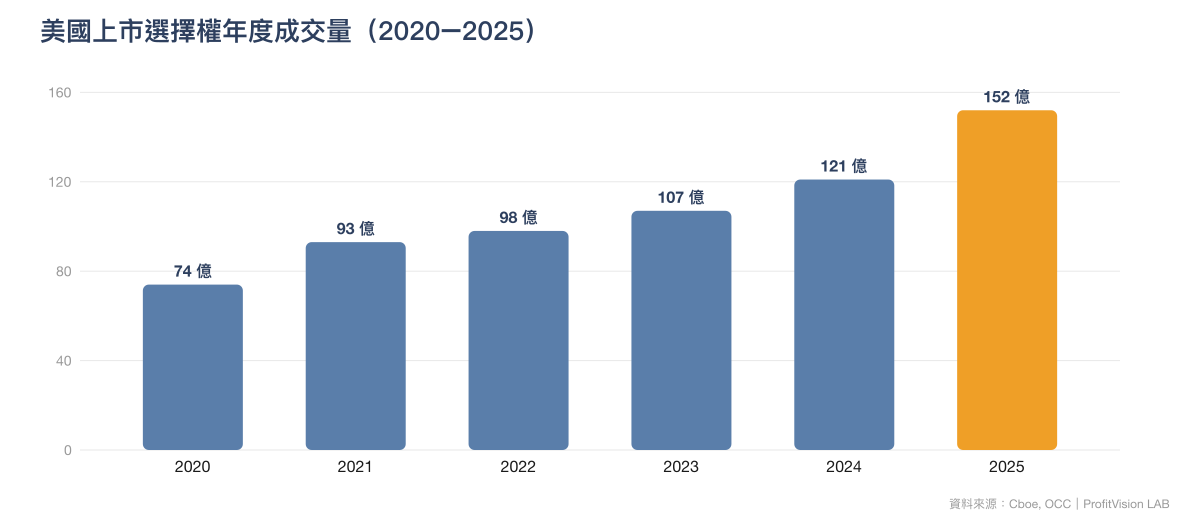
What's driving all of this isn't a single factor — it's three forces resonating together:
Force One: The 0DTE Revolution
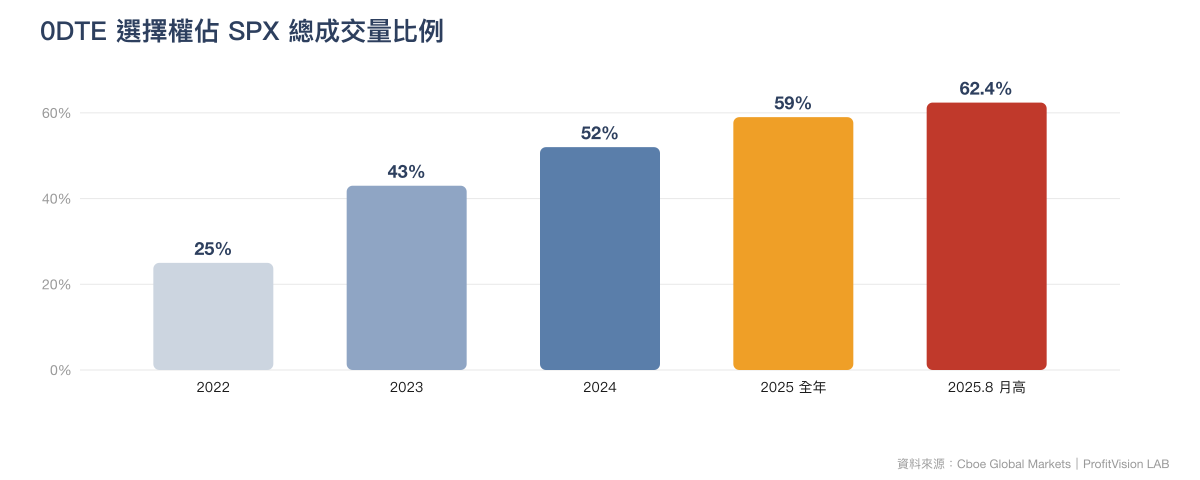
Zero-days-to-expiration options (0DTE) have gone from a niche play to a market mainstream. SPX 0DTE options averaged 2.3 million contracts traded daily in 2025, accounting for 59% of total SPX volume. Even more notable, 0DTE's share of overall U.S.-listed options volume climbed from roughly 12% in 2022 to 24.1% in 2025.
This isn't a fleeting bout of speculation. Data shows that over 95% of 0DTE trades use limited-risk formats (buying options or spread strategies), with naked short selling making up just 4%. The discipline retail investors are showing in 0DTE trading far exceeds market expectations.
Force Two: Structural Retail Participation
The explosive growth of zero commissions, mobile trading apps, and options education content has turned strategies once reserved for hedge funds — credit spreads, iron condors — into everyday tools for retail traders. Retail brokerage flow accounts for 50% of total options volume, and as high as 50–60% within SPX 0DTE.
Force Three: Structurally Elevated Volatility
The macro backdrop of 2025–2026 — interest rates chopping around at high levels, geopolitical conflict in the Middle East, and skepticism over AI investment returns — has kept the VIX at relatively elevated levels. The higher volatility runs, the greater demand for options: hedgers need protection, speculators need to capture the swings, and market makers need more liquidity. This forms a positive feedback loop, and CBOE sits right at its center.
Layer Two: Competitive Landscape — Who's Selling the Shovels?
An Oligopoly Among Exchanges
The global financial exchange market is dominated by a handful of giants. CBOE's direct competitors include CME Group (the king of futures), ICE (parent of the NYSE), and Nasdaq (roughly 27.8% share of U.S. options — its most direct rival).
CBOE's Irreplaceability
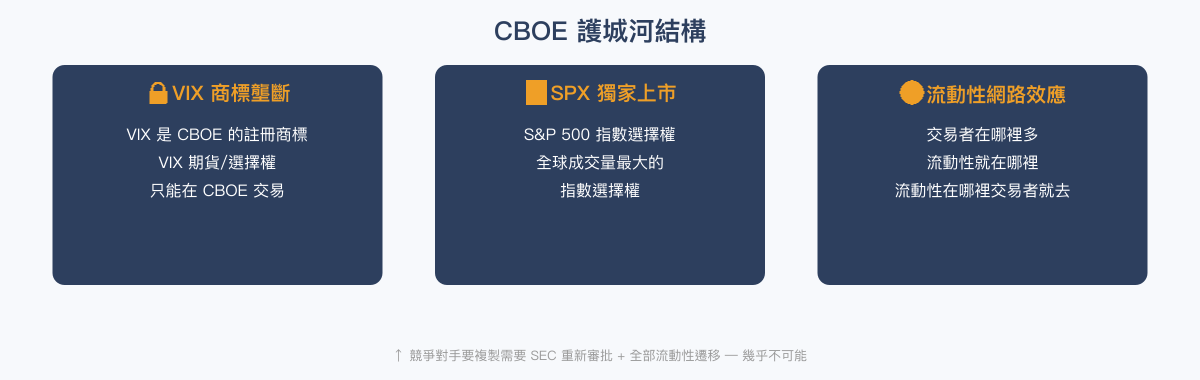
Within this competitive landscape, CBOE holds a moat no other exchange can replicate: a monopoly on proprietary products.
VIX (the volatility index) is a registered CBOE trademark. VIX futures and options can only trade on CBOE. SPX options (S&P 500 index options) are listed exclusively on CBOE and are the highest-volume index options in the world. For a competitor to replicate this advantage, it would need to create an alternative volatility index and persuade market participants to migrate their liquidity — under the double protection of network effects and regulatory barriers, that's nearly impossible.
As of early 2025, CBOE held an overall share of roughly 30.4% of the U.S. options market, ranking first. But the real value lies in the fact that in the high-margin index options segment, CBOE's share is far higher than that, because SPX and VIX products simply have no substitutes.
That's why CBOE isn't just "an exchange" — it's "the infrastructure monopolist of the options market."
Layer Three: Company Anatomy — What Is CBOE Actually Making Money From?
Five Major Business Segments
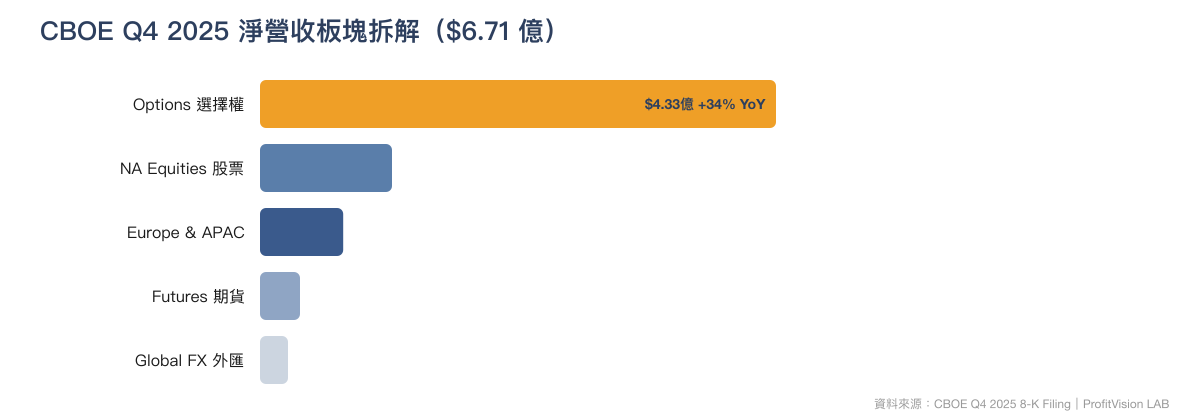
The options segment contributes nearly two-thirds of revenue and is also the fastest-growing segment. Q4 net transaction and clearing fees from options grew 40% year over year, driven by a 35% increase in average daily volume for index options and a 20% increase for multiply-listed options.
Data Vantage: An Underappreciated Recurring-Revenue Engine
Beyond trading fees, CBOE has a business Wall Street is increasingly paying attention to — Data Vantage, its market data and analytics service. Q4 2025 net revenue reached $160 million, up 9% year over year. While its growth rate doesn't match the flashier derivatives segment, this is subscription-based recurring revenue that isn't affected by any single quarter's trading volume swings.
2026 guidance: Data Vantage's organic revenue growth target is "mid to high single-digit." As CBOE moves forward with near-24/5 trading, global investors' demand for real-time market data will only grow — Data Vantage's ceiling is far from reached.
Full-Year Financial Performance
| Metric | Full Year 2025 | YoY |
|---|---|---|
| Net Revenue | $2.4B | +17% |
| GAAP Diluted EPS | $10.42 | +45% |
| Adjusted Diluted EPS | $10.67 | +24% |
| Gross Margin | 51.5% | — |
| Net Margin | 23.2% | — |
| ROE | 23.3% | — |
Growth Catalysts: Three Arrows
Arrow One: The 0DTE Flywheel Effect
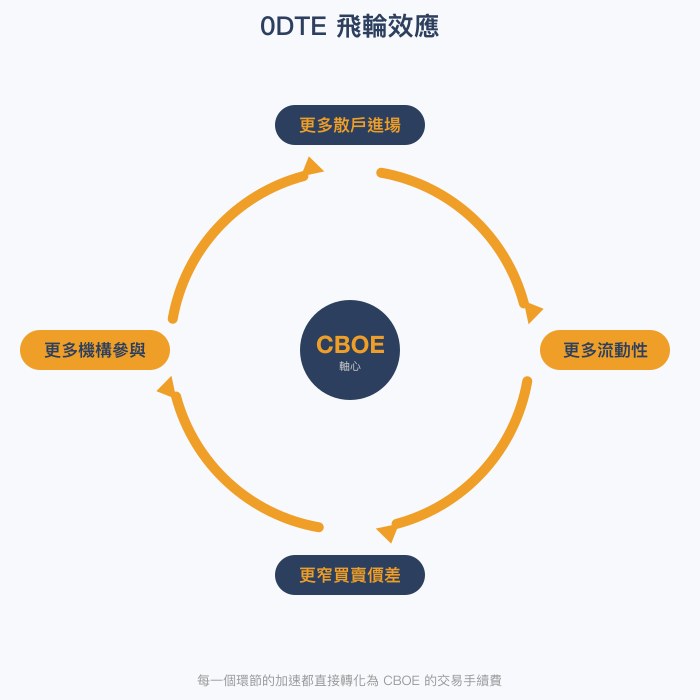
0DTE options growth isn't linear — it's a flywheel. More retail participation → more liquidity → tighter bid-ask spreads → more institutions willing to participate → more product innovation (like Bitcoin ETF index options, Magnificent 10 index options) → attracting even more participants. CBOE sits at the hub of this flywheel.
In 2025, SPX 0DTE averaged 2.3 million contracts in daily volume, 59% of total SPX volume. In August 2025, it briefly touched an all-time high of 62.4%. As brokerages continue expanding their derivatives product lines and FINRA moves to relax day-trading restrictions on small accounts (the Pattern Day Trading Rule), 0DTE penetration still has room to run higher.
Arrow Two: Near-24/5 Trading
On March 16, 2026, CBOE filed a proposal with the SEC for near-24×5 U.S. equities trading. The plan would extend trading hours for all NMS stocks on the EDGX exchange from Sunday 9pm to Friday 8pm (Eastern time), with only a one-hour maintenance window each night. The target launch date is December 2026.
This isn't a moonshot. CBOE has already set record volumes during SPX/VIX options' global trading session (8:15pm to 9:25am); CBOE FX is already a genuine 24/5 market; and CBOE's early-morning trading session (4am to 7am) saw average daily volume grow 590% from February 2022 to February 2026.
The significance of round-the-clock trading isn't just more transaction fees — it gives CBOE's Data Vantage market-data business a round-the-clock source of demand, which is especially critical infrastructure for Asia-Pacific and European investors accessing the U.S. equity market.
Arrow Three: The New CEO's "2026 Refocus" Strategy

In May 2025, former CME Group CEO Craig Donohue took over as CBOE's chief executive. His strategy is clear: "pruning the garden" — divesting the low-margin cash equities business and concentrating resources on high-growth derivatives and recurring data services.
The SEC's Tick Size and Access Fee amendments, implemented in late 2025, compressed margins in cash equities — which, if anything, validated Donohue's direction. Wall Street sees him as a "derivatives purist," and his experience at CME gives him the ability to navigate a complex regulatory environment.
Risk Checklist
| Risk Type | Description | Severity |
|---|---|---|
| 0DTE Regulatory Risk | Regulators continue to debate whether 0DTE exacerbates intraday flash crashes. Any restrictions on 0DTE products would directly hit CBOE's largest growth engine. | High |
| Product Concentration | SPX options account for the overwhelming majority of revenue. Compared with the more diversified footprints of ICE and CME, CBOE is more dependent on a single product line. | Medium-High |
| Trading Volume Cyclicality | Even with Data Vantage as a buffer, core revenue remains highly dependent on trading volume. If the market enters an extended period of low volatility (as in 2017), revenue would come under clear pressure. | Medium |
| Valuation Isn't Cheap | Shares trade around $300, with a forward P/E of roughly 23.6x. Goldman Sachs maintains a "Sell" rating. Near all-time highs, the market has already priced in substantial optimism. | Medium |
| New Entrant Threat | IEX Options is expected to launch in 2026, and MEMX plans to add a second venue, which would bring the number of U.S. options exchanges to 20. While this poses no direct threat to CBOE's proprietary products, its share of multiply-listed options will face more competition. | Medium-Low |
Valuation and Positioning
| Metric | CBOE | CME | ICE | NDAQ |
|---|---|---|---|---|
| Share Price (approx.) | $300 | $320 | $165 | $85 |
| Forward P/E | ~23.6x | ~24x | ~22x | ~21.6x |
| Net Margin | 23.2% | ~57% | ~27% | 21.6% |
| ROE | 23.3% | ~12% | ~13% | 15.3% |
| 2025 Revenue Growth | +17% | ~+10% | ~+13% | +13% |
| 2025 EPS Growth | +45% (GAAP) | ~+7% | ~+14% | +60% (GAAP) |
CBOE's valuation is in line with its peers, but its EPS growth rate is far higher than CME's or ICE's. Its ROE also stands well above peers, reflecting an asset-light model and the high marginal profitability of its proprietary products.
ProfitVision LAB's View
Industry Trend: The options market has set records for six straight years, the 0DTE revolution is still accelerating, and structural retail participation is an irreversible trend. ✅
Competitive Landscape: The proprietary-product monopoly on SPX and VIX is one of the strongest moats in all of finance. Competitors cannot replicate it. ✅
Company Quality: ROE of 23%, EPS growth of 45% year over year, gross margin of 51%, and an asset-light model with essentially no net-debt pressure. ✅
Growth Catalysts: The 0DTE flywheel, near-24/5 trading, and recurring Data Vantage revenue. ✅
Key Risks: 0DTE regulatory uncertainty, product concentration, and a valuation at all-time highs. ⚠️
One-line summary: CBOE isn't the cheapest exchange stock, but it's the fastest-growing one. Against the backdrop of a structural boom in the options market, its monopoly on proprietary products makes it a rare combination of "wide moat plus high growth."
📚 Financial Infrastructure Deep Research Series
1️⃣ CBOE: The Ultimate Business of Selling Shovels to Gold Miners (this article)
2️⃣ NDAQ: Not Just an Exchange, but Finance's Answer to AWS
3️⃣ CBOE vs. NDAQ: Derivatives Purism vs. Fintech Platform
4️⃣ Coinbase (COIN): How Far Can Crypto's "Neighborhood Convenience Store" Go?
5️⃣ Crossing Boundaries: The Three-Way Contest of CBOE × NDAQ × COIN
Disclaimer: This article is for research reference only and does not constitute any investment advice. All investment decisions should be based on your own risk tolerance and independent judgment. Data cited in this article comes from public filings (CBOE SEC Filings), Cboe Global Markets' official data, and third-party analytics platforms. Article written on April 2, 2026.
© 2026 ProfitVision LAB | US Equity Options × Deep Research × AI in Practice