A One-Person Research Lab: How I Use an AI Toolchain to Produce Institutional-Grade Stock Research
In the past, deep stock research was the exclusive domain of institutions. Now, with an AI toolchain — a research prompt framework, automated Ghost publishing, compliance review, and cover-image generation — one person can produce three 10,000-word institutional-grade research reports a week. Here's the complete breakdown of that workflow.
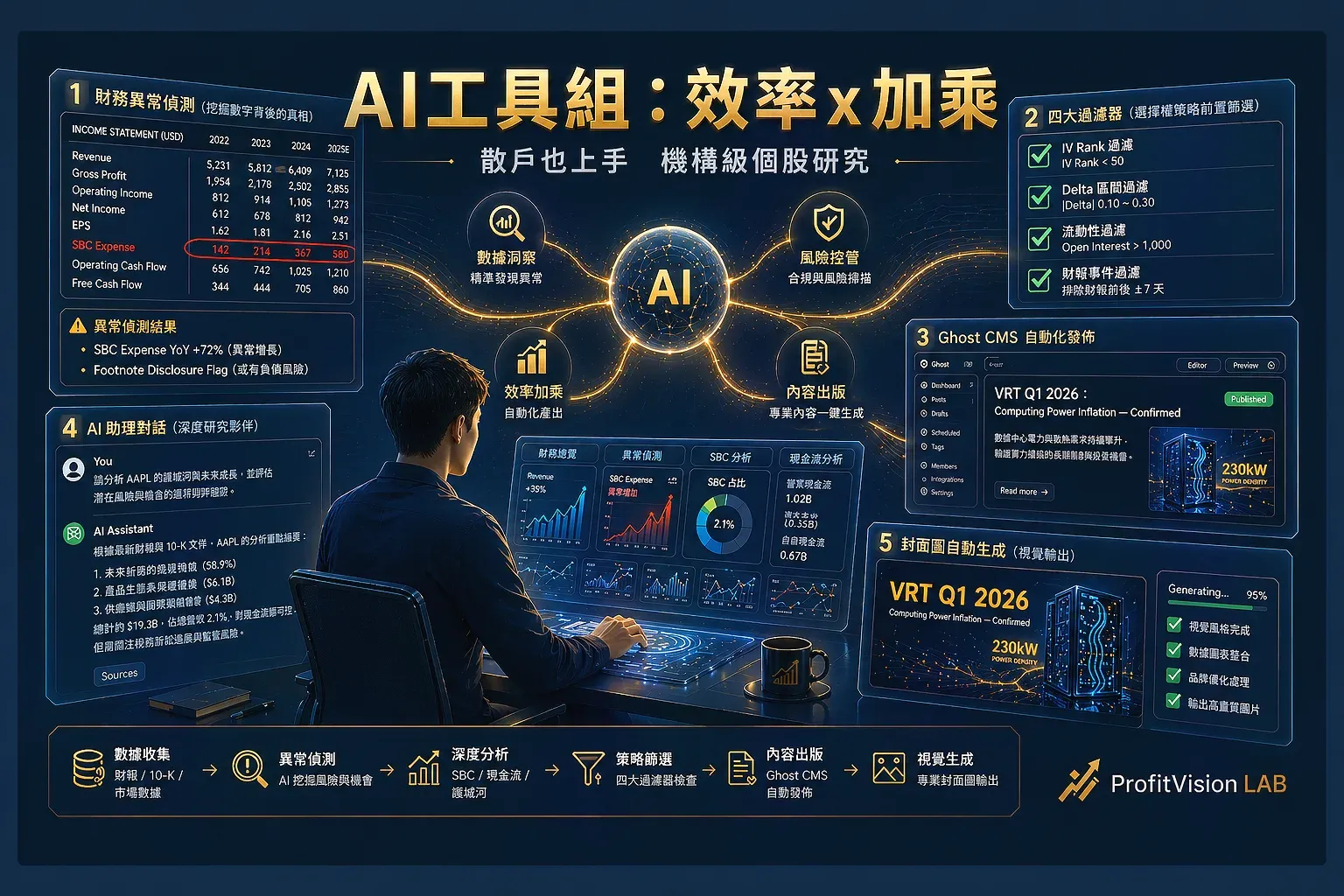
A One-Person Research Lab: How I Use an AI Toolchain to Produce Institutional-Grade Stock Research
From prompt frameworks and Ghost publishing, to compliance review and cover-image generation — this workflow lets me produce three deep-research articles a week
Now that boundary has disappeared.
AI handles the grunt work, you handle the judgment. The difference isn't the tools — it's whether you've built a repeatable process.
1. Where This Workflow Came From
The stock research I've published on ProfitVision LAB covers MCO, SHW, CTAS, CDNS, SPGI, NET, ZS, FN, NOW, and TSMC — each piece 8,000 to 12,000 words, including financial charts, a Four-Layer Defensive Screen assessment, and options trading recommendations. These articles weren't produced the traditional way — I don't have a Bloomberg terminal, I don't have a team of analysts, and I have a day job to run at the same time.
All of this research is produced through an AI toolchain. This article lays that toolchain out in full: how each stage — research production, platform publishing, compliance review, and visual design — actually works, and every pitfall I hit along the way.
2. A Three-Layer Architecture: Research, Publishing, Tracking
The whole workflow has three layers, each supported by its own set of AI tools:
- Layer One: Research Production — a five-stage research process driven by a prompt framework
- Layer Two: Platform Infrastructure and Content Distribution — automated Ghost CMS publishing + distribution to four social platforms
- Layer Three: Earnings Tracking and the Update Cycle — version-controlled management, because research isn't finished once it's written
Underneath all of it is CoWork's Skill system, which locks each step of the process into place, so I'm not re-explaining to Claude from scratch every time what needs to happen.
3. Layer One: The Prompt Framework for Research Production
Research Core
Before you understand the business model, no number means anything. Use a "revenue-position analysis" framework to ask the first question: where does this company sit in its industry's value chain? Why do customers have to pay it? What are the alternatives?
The most valuable part of financial analysis isn't confirming what you already know — it's finding the anomaly you hadn't noticed. This is meticulous work, but AI does it extremely well: it proactively surfaces things you didn't even think to ask about.
In practice, this prompt has caught two categories of high-value anomalies:
SBC doesn't stand out on the income statement, but it's real shareholder dilution. Claude will flag it: "This company's SBC-to-revenue ratio is 18%, far above the 8–10% typical of peers, meaning Non-GAAP EPS is significantly flattered — GAAP-basis profitability is much worse than the reported number suggests." This is a judgment that's easy to miss when reading footnotes manually, but AI flags it instantly.
Operating lease obligations, litigation contingencies, off-balance-sheet commitments — these sit in the footnotes, never make it onto the main statements, but can become real cash outflows under the right conditions. After reading the footnotes, Claude will flag: "Note 14 discloses undisclosed lease commitments totaling $X hundred million, equivalent to 40% of current cash on hand — the balance sheet's real resilience to an FCF shock is lower than the headline numbers suggest." Almost nobody who isn't actively reading the footnotes will ever catch this detail.
Worth noting: this isn't just a retail-investor blind spot. Institutions get burned by off-balance-sheet liabilities all the time too — footnotes routinely run dozens of pages, and even professional analysts don't always read every one of them in full. AI's edge is that it doesn't get tired and doesn't skip anything.
Having Claude challenge your assumptions is more valuable than having it confirm them.
Industry positioning 30 min → financial breakdown 45 min → moat verification 30 min → risk inventory 30 min → valuation synthesis 45 min
Total: 3 hours, to produce an 8,000–12,000-word research report.
4. Layer Two: Ghost Publishing and Compliance Review
Platform Infrastructure
Once the research is written, it goes into a Node.js publishing script. Every pitfall hit here is worth writing down:
| Error Type | Root Cause | Fix |
|---|---|---|
| SyntaxError: Unexpected identifier | A JS single-quoted string contains an apostrophe (Moody's, S&P Global) | Switch to backtick template literals |
| SVG icon text too small | Fixed px sizing breaks after scaling | Switch to an HTML+CSS div, size text in em units |
| Ghost API 422 error | custom_excerpt exceeds 300 characters | Strictly cap it at under 280 characters |
| API connection failure | Using the custom domain instead of .ghost.io | Always use profitvisionlab.com for the JWT auth URL |
Compliance Review: A Required Step Before Every Publication
Under Taiwan's investment advisory regulations, an entity that isn't a legally registered investment advisor cannot issue entry, exit, or trading instructions. Every article that references a stock ticker or an options strategy must pass a compliance Skill scan before publishing:
- Directive language ("you can enter now," "set your stop at XX") → rewritten as descriptive scenarios
- Specific share counts, dollar amounts, or personal account parameters → all removed, replaced with framework language like "cap as a share of a single position in the portfolio"
- Every article must carry a disclaimer at the bottom, explicitly stating it is not a legally registered investment advisor
5. Layer Three: Earnings Tracking and Versioned Updates
Ongoing Tracking
Research isn't finished once it's written. Every stock-research article has a corresponding earnings-tracking checklist, which triggers an update process once new earnings are released:
Level A (thesis reversal) → full rewrite; Level B (routine update) → revise key sections; Level C (data update) → refresh table data
The v1.0 original is preserved, with an update notice at the top linking to v2.x — readers can see the latest view while the historical context stays accessible
6. The CoWork Skill System: Locking the Process into Reusable Skills
Infrastructure
| Skill Name | Function |
|---|---|
| CANSLIM Screener | Reads a MarketSurge Excel export, applies six thresholds, outputs a branded HTML report |
| Deep Stock Research | Six-chapter structural template + brand colors + Four-Layer Screen quick-reference table |
| Ghost CMS Publishing | JWT authentication + Lexical HTML Card + excerpt rules + tag mapping |
| Options Four-Layer Screen | Chip flow → moat → volatility → technicals, outputting Clear / Watch / Reject |
| Cover-Image Prompt Generator | Three visual-style templates, outputting a complete prompt usable with ChatGPT Image 2 |
| Earnings Tracker | CoWork scheduled tasks + update-level determination + revision checklist |
| Compliance Review | Scans for risky wording, outputs Clear / Needs Revision / Rejected |
| Brand Trilingual Standard | Traditional Chinese / English / Japanese terminology mapping, auto-checked before publishing the English version |
| Social Distribution | Automatically converts a Ghost article into native-format copy for four platforms |
7. Claude + ChatGPT Image 2: The Visual Workflow
Cover Generation
- Claude reads the article's category and core thesis, and produces a complete English prompt following one of three templates (Research / Strategy / Commentary)
- The prompt includes: scene composition, lighting direction, brand color values (#2d3f5e / #EF9F27), and a list of banned elements
- ChatGPT Image 2 takes the prompt and generates the image
- When Chinese text needs to be overlaid, it's added in Canva instead (AI image generation still has a high misread rate for Chinese characters)
This division of labor keeps every article's cover image, from concept to usable asset, reliably under 10 minutes. Site-wide visual consistency has gone from "wildly different article to article" to "instantly recognizable as ProfitVision LAB."
8. Real-Time Debugging: The Single Biggest Efficiency Change
Efficiency Key
Claude can read locally uploaded files (MarketSurge Excel exports, financial CSVs, script error messages), and with authorization, can read specified web pages. The deepest change this has made to my working rhythm is: real-time debugging.
In the past, when a script errored, I'd copy the error message, explain the context, and wait for a reply. Now I just paste the terminal output directly to Claude — it cross-references your script and gives a precise fix in one round. Node.js SyntaxErrors, Ghost API 422 errors, expired JWTs — the average fix time for these errors has dropped from 15 minutes to 2 minutes.
AI handles fast organization, questioning, structuring, and mechanical execution — the grunt work.
You handle judging what matters, which assumptions are reasonable, and whether to ultimately buy — the thinking.
The Skill system locks this division of labor in place, so it doesn't depend on the quality of any single conversation.
This workflow currently covers 30+ research articles, and Ghost traffic has already surpassed the original Vocus platform. If you'd like to see the concrete output, check out this site's stock-research series.